What’s In This Guide
- What Makes a Commercial Kegerator Different From a Home Unit?
- Is a Commercial Kegerator the Right System for Your Venue?
- 7 Factors to Weigh Before You Buy a Commercial Kegerator
- True vs. Beverage-Air: Commercial Kegerator Comparison
- Components You Need Beyond the Cabinet
- How Much Does a Commercial Kegerator Cost?
- Plan the Installation Before the Unit Arrives
- Keep It Clean: Maintenance for Any Commercial Kegerator
- Finding the Right Installer for Your Commercial Kegerator
- Frequently Asked Questions
- Get the Right Commercial Kegerator Set Up Correctly
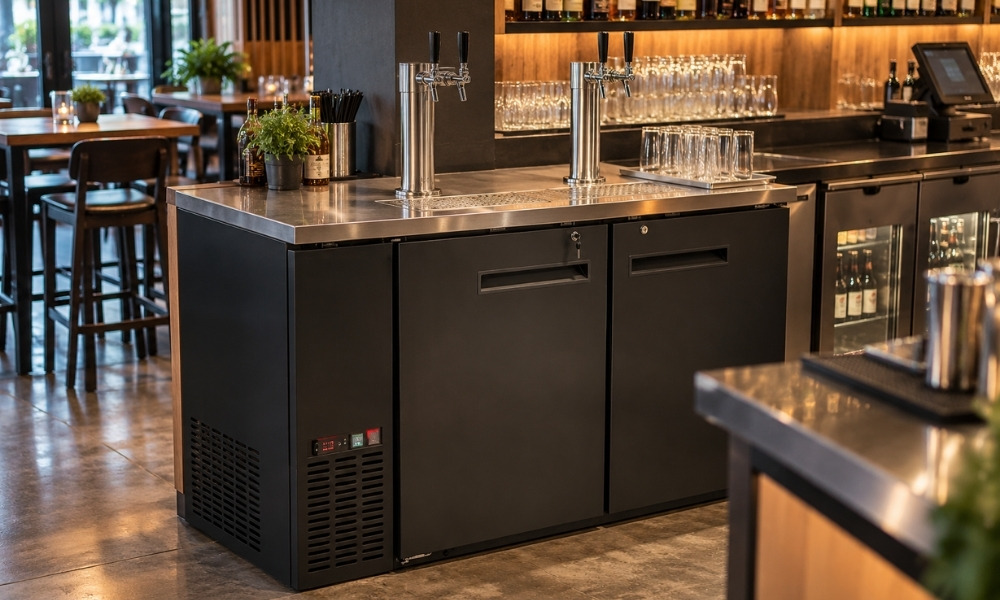
A commercial kegerator might seem like a straightforward purchase until a busy Friday night test reveals its limits. That is when an undersized unit runs warm, a poorly cooled tower pours excess foam, or insufficient keg capacity forces staff to swap kegs during peak hours. The model you select determines pour quality, inventory capacity, and routine maintenance requirements for years to come.
Quick Facts
- A commercial kegerator suits short runs between keg and faucet.
- Match half-barrel capacity and tap count to weekly keg turnover.
- Look for NSF or UL sanitation listings and forced-air cooling.
- Budget separately for CO₂, regulators, couplers, and lines.
- Clean lines every two weeks, whatever brand you buy.
What Makes a Commercial Kegerator Different From a Home Unit?
A commercial kegerator is a self-contained refrigerated cabinet with a tower and faucets, built for continuous daily service. Home units are generally designed for lighter use and may lack the refrigeration capacity, commercial sanitation certifications, and reinforced interiors that a busy bar requires.
Commercial-grade models share a few traits:
- Forced-air cooling that recovers quickly after the door opens during service
- Stainless or galvanized interiors with reinforced floors for full-weight half-barrel kegs
- Insulated towers that push cold air to the faucet, which reduces first-pour foam
- Sanitation and safety listings such as NSF/ANSI 7 or UL Sanitation
- Commercial warranties that often exclude residential use
Warranty terms warrant careful attention: some commercial manufacturers exclude residential installations from warranty coverage. Similarly, using a residential unit in a commercial venue may void its warranty if commercial use is excluded. Check the manufacturer’s warranty terms before purchasing to avoid unexpected repair costs.
Is a Commercial Kegerator the Right System for Your Venue?
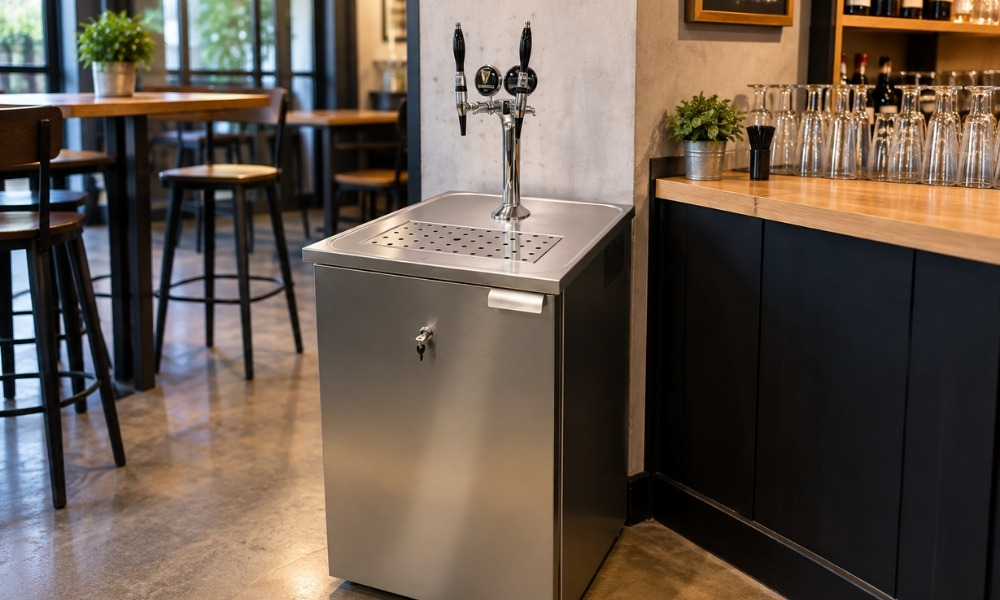
A commercial kegerator is a direct-draw system: the keg sits in the cabinet directly beneath the tap. That keeps beer lines short, which simplifies balancing and avoids the cost of a glycol chiller.
It fits best when you run a handful of taps and the kegs can live at or under the bar. Venues with a remote walk-in cooler or a large tap count may need a different draft system. Shorter remote runs can use forced-air cooling, while systems extending beyond roughly 25 feet typically require glycol cooling.
Mapping distance, tap count, and cooler placement early is part of draft beer line installation planning, and it decides which category you are shopping in before you compare a single model.
7 Factors to Weigh Before You Buy a Commercial Kegerator
1. Keg Capacity and Tap Count
Start with how many half-barrel kegs you move per week. A half-barrel holds 15.5 gallons, which yields roughly 124 sixteen-ounce pours. A single-keg unit is fine for one steady seller, but a rotating menu needs more slots.
Sixtel kegs change the math. Many commercial cabinets hold two sixtels in the space of one half-barrel, so a rotating craft list can fit in fewer square feet. Confirm sixtel rack compatibility with the manufacturer before assuming it.
2. Cabinet Size and Footprint
Measure the available bar area and the entire path the unit must take during delivery. For instance, a representative two-keg model like the True TDD-2-HC spans roughly 59 inches in width, whereas compact single-keg units from other manufacturers can feature footprints as narrow as 24 inches. Be sure to verify door swing clearance, hallway dimensions, and entryways. Additionally, maintain adequate ventilation space around the condenser airflow points to prevent overheating.
3. Cooling Performance and Temperature Range
Temperature control is the whole job. The Brewers Association’s Draught Beer Quality Manual recommends keeping kegs at or below 38°F for dispensing. A keg delivered at 44°F may need approximately 18 hours of refrigeration, while one at 50°F may need 25 hours to reach the recommended temperature. Spec sheets show the range each cabinet is built to hold:
- True lists 33°F to 38°F for its direct draw dispensers
- Beverage-Air lists 36°F to 38°F on its direct draw models
Actual temperatures fluctuate with room conditions, door usage, and airflow. A unit maintaining temperature in a cool space may struggle in a warm, high-traffic area. If it stays above 38°F or pours foamy beer, kegerator repair can fix cooling and pouring issues before replacing the cabinet.
4. Build Quality and Certification
Look for NSF/ANSI 7 compliance, UL EPH classification, or UL Sanitation on the spec sheet for the specific model. These certifications indicate compliance with applicable sanitation standards, though they do not replace local inspection requirements. Confirm what applies to your venue with the local health department before purchase.
Inside the box, a reinforced stainless floor matters. Half-barrel kegs weigh about 160 pounds each, so a two-keg cabinet carries a serious load.
5. Tower Design and Faucet Capacity
Insulated towers with forced-air cooling channel cold air toward the faucets, helping maintain beer temperature and reduce first-pour foaming. Evaluate the number of faucets included and whether the tower design supports expansion. Single-tap towers work well for targeted offerings, whereas multi-faucet columns or multiple towers accommodate broader tap lists.
Taprooms that outgrow a cabinet tower often move toward a feature wall. In that case, tap wall design for breweries becomes the next planning step, because a wall changes your cooling and line-routing requirements entirely.
6. Electrical and Refrigerant Details
Many direct-draw units operate on 115V power with a NEMA 5-15P plug, but confirm the electrical requirements before delivery. Some manufacturers require a dedicated circuit, so have an electrician verify the installation requirements. Many current models use hydrocarbon refrigerants such as R290, which explains the “HC” designation in certain model numbers.
7. What Ships With the Unit
Never assume dispensing hardware is included with the refrigeration unit. Many commercial kegerator models are sold as basic cabinets, requiring the CO₂ cylinder, regulators, gas and beer lines, and keg couplers to be purchased separately. Planning for these additions prevents setup delays when the unit arrives.
True vs. Beverage-Air: Commercial Kegerator Comparison
True and Beverage-Air are two established manufacturers of commercial draft beer equipment. A True kegerator is available in multi-keg configurations, while a Beverage-Air kegerator offers compact, single-keg footprints alongside larger models. Here is how representative units compare:
|
Feature |
True TDD-2-HC |
Beverage-Air BM23HC-C-B |
Beverage-Air DD36HC-B |
|
Half-barrel capacity |
2 |
1 |
1 |
|
Width |
~59 in. |
24 in. |
36 in. |
|
Taps |
2 columns |
1 tap |
Dual-faucet column |
|
Cabinet temperature |
33°F to 38°F |
36°F to 38°F |
36°F to 38°F |
|
Listings noted |
NSF/ANSI 7 |
Verify current model certifications |
Verify current model certifications |
|
Best fit |
Busy bars, two core beers |
Compact bars, one anchor beer |
Tight back bars, two taps |
Note: Models and specs change, so verify current details with the manufacturer or your installer before ordering.
Neither brand is automatically better. The right choice depends on your keg count, space, and how hard the unit will work on a peak night.
Components You Need Beyond the Cabinet
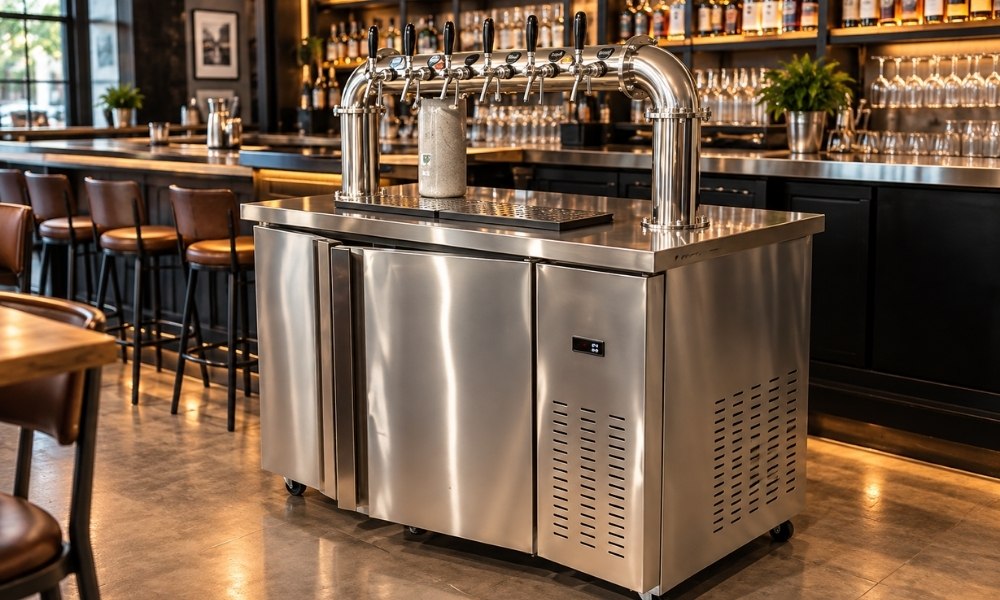
The cabinet is only one part of a working draft system. Gas supply, regulators, couplers, beer lines, and faucets all affect how the beer pours, and a mismatch in any of them causes foam or flat beer. A clear picture of draft beer system components helps you budget accurately and avoid surprise purchases after the kegerator arrives.
Pay attention to line material and length as well. Standard flexible vinyl lines used in direct-draw kegerators degrade over time and absorb flavor compounds, making annual line replacement a recommended best practice for draft hygiene.
How Much Does a Commercial Kegerator Cost?
Equipment pricing varies widely depending on cabinet size, tap count, exterior finish, and included hardware. Single-keg units generally start at lower price points, while multi-keg stainless steel models with specialized towers cost significantly more.
What moves your estimate:
- Keg and tap capacity: more slots and faucets raise the cost
- Finish and build: stainless exteriors and club-top designs cost more
- Gas and line hardware: often purchased separately
- Delivery, placement, and electrical needs: access and site conditions matter
- Installation and balancing: scope depends on your layout
- Urgency: rush orders and backordered models can change timing and price
A personalized estimate beats a guess, especially if you are weighing a cabinet against a larger system.
Plan the Installation Before the Unit Arrives
Proper installation is essential for reliable operation. Applied pressure, line resistance, coupler specifications, and refrigeration settings must all be calibrated to match the specific beverages being poured. Unbalanced systems frequently pour excess foam, leading to wasted product and unnecessary operational downtime, so build installation and balancing into your bar opening checklist well before the first service.
A trusted provider like Beer Line Cleaning USA designs and installs commercial draft systems for bars, restaurants, breweries, and venues across New York, New Jersey, and Connecticut. With thousands of draft systems installed, cleaned, repaired, and maintained, the company has extensive experience in draft system service.
Keep It Clean: Maintenance for Any Commercial Kegerator
Buying a premium cabinet does not eliminate the need for regular line cleaning. The Brewers Association recommends cleaning beer lines biweekly, fully disassembling faucets during service, and performing quarterly acid descaling to prevent beer stone. Neglecting maintenance leads to excessive foam, off flavors, and cloudy pours.
Daily upkeep includes wiping the tower and drip tray, verifying cabinet temperatures, and clearing dust from the condenser. Staff should perform cleaning using proper beer line cleaning equipment, such as pressurized containers and faucet brushes.
Finding the Right Installer for Your Commercial Kegerator
Selecting quality equipment is only half the battle; proper installation and routine maintenance are equally important. When evaluating draft service providers, ask about their technical experience, service response times, and familiarity with your specific equipment brands.
Frequently Asked Questions
Can a commercial kegerator dispense beverages other than beer?
Yes. Some commercial kegerators can dispense cider, hard seltzer, kombucha, and other kegged beverages. However, different drinks may require specific gas blends, pressure settings, couplers, and beverage-compatible tubing. Confirm compatibility with your draft system installer before switching beverages.
Should a bar buy a new or used commercial kegerator?
A used commercial kegerator can reduce upfront costs, but its condition matters more than its age. Check compressor performance, door seals, refrigeration components, and signs of corrosion. New units generally offer manufacturer warranties, while used equipment may require repairs or replacement parts sooner.
Can a commercial kegerator be installed outdoors?
Only if the manufacturer specifically rates the unit for outdoor installation. Standard indoor commercial kegerators may struggle with rain, humidity, and extreme temperatures. Outdoor-rated equipment should be installed according to manufacturer clearance, electrical, and ventilation requirements.
How much ventilation space does a commercial kegerator need?
Clearance requirements vary by manufacturer and model. Some units need open space behind or beside the cabinet, while front-breathing models may support tighter installations. Follow the manufacturer’s specifications to prevent restricted airflow, overheating, and unnecessary compressor strain.
Can a commercial kegerator be converted to accommodate additional taps?
Some models support additional faucets, but compatibility depends on tower design, cabinet capacity, and available connections. Adding taps may require modifications to gas distribution, beer lines, and tower cooling. Consult the manufacturer or a qualified draft system technician before making changes.
Get the Right Commercial Kegerator Set Up Correctly
Selecting the right commercial kegerator comes down to matching capacity, cooling performance, and overall design to your venue’s real-world service volume. Professional installation and ongoing line hygiene protect your investment and help maintain consistent pour quality.
Not sure whether a kegerator or a larger system fits your bar? Talk to a draft system expert at Beer Line Cleaning USA about sizing, installation, and a cleaning schedule built around your volume.