Learning how to clean draft beer lines at home is a straightforward process that requires a food-safe line cleaning solution, a hand pump or pressurized cleaning kit, and about 30 to 60 minutes. Moreover, skipping this maintenance allows bacteria, yeast, and beer stone to accumulate inside the lines. As a result, this produces flat, off-tasting beer and potentially introduces harmful microorganisms into every pour.
Table of Contents
- Why Line Cleaning Cannot Be Skipped
- What You Need Before You Start
- How to Clean Draft Beer Lines at Home: Step-by-Step Process
- How Often Home Draft Lines Should Be Cleaned
- Things to Know When Cleaning Draft Beer Lines
- When Professional Cleaning Makes More Sense
Key Takeaways
- Clean draft beer lines every two weeks at minimum, per the Brewers Association Draught Beer Quality Manual.
- A caustic cleaner (alkaline) handles organic deposits; an acid cleaner addresses beer stone and mineral buildup.
- Always flush the lines thoroughly with cold water after any cleaning solution to prevent chemical carry-over into the beer.
- Improper cleaning technique can damage seals, faucets, and couplers — replacing parts costs more than doing the job correctly the first time.
- Long-draw glycol systems and multi-tap setups are significantly more complex and typically warrant professional servicing.
- The home draft beer dispenser market is valued at $126.36 million in 2025, reflecting how common at-home systems have become (according to Mordor Intelligence, 2026).
Why Line Cleaning Cannot Be Skipped
Beer is an organic product. The moment it passes through a draft line, it leaves behind proteins, yeast cells, hop resins, and minerals. Additionally, at room temperature, those residues form a biofilm inside the tubing within days. Left unchecked, that biofilm produces acetic acid bacteria and wild yeast strains that directly alter the flavor and aroma of every subsequent pour.
The science behind this is well-documented at the commercial level. According to Ontrack Software, citing multiple industry sources (2025), accounts that clean their draft lines every two weeks sell an average of 3 to 4% more beer than those that clean infrequently. Furthermore, this increased sales occurs because the product tastes the way the brewer intended. The same principle applies at home: a clean line produces a clean pour.
What You Need Before You Start
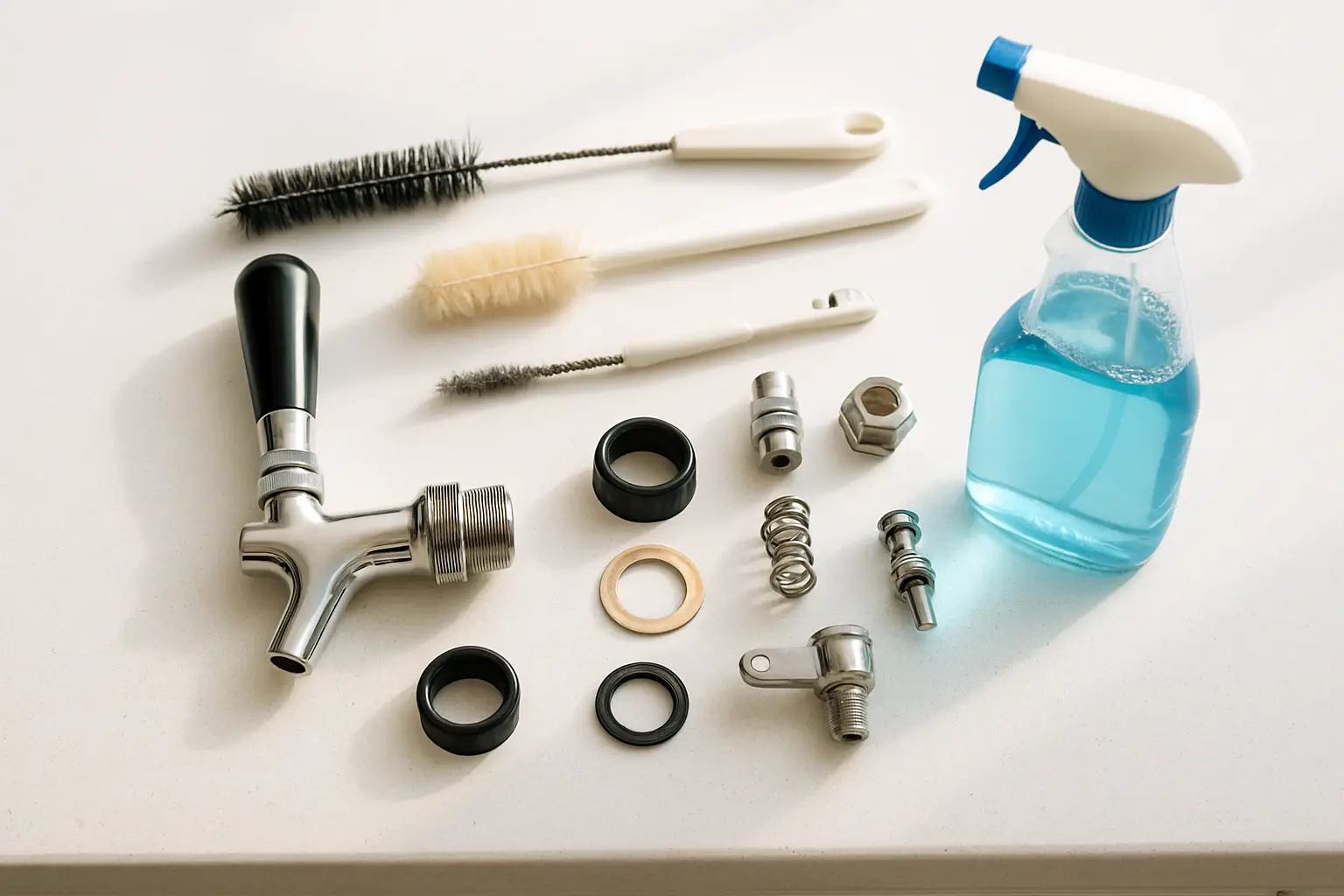
Gathering the right supplies before beginning prevents mid-process interruptions. Here is what you need for a standard home kegerator or single-tap direct-draw setup:
Cleaning supplies:
- Food-grade alkaline (caustic) line cleaner
- Food-grade acid cleaner (for periodic beer stone removal)
- A hand pump cleaning kit or pressurized cleaning bottle
- A clean bucket (at least 1 gallon capacity)
- Line cleaning brushes sized for faucets and couplers
- Food-safe lubricant for faucet seals
- Warm water (not hot) for mixing solutions
Basic equipment checklist:
| Item | Purpose |
|---|---|
| Hand pump or pressurized bottle | Pushes cleaning solution through the line |
| Alkaline cleaner | Removes organic deposits (proteins, yeast) |
| Acid cleaner | Removes beer stone (calcium oxalate) |
| Faucet brush | Scrubs interior of the faucet body |
| Coupler brush | Cleans the coupler probe and body |
| Food-safe lubricant | Protects and seats faucet seals after reassembly |
Always follow the manufacturer’s dilution ratios on the cleaner label. In addition, using a solution that is too concentrated can degrade vinyl tubing and rubber seals faster than normal wear.
How to Clean Draft Beer Lines at Home: Step-by-Step Process
The process below applies to a standard single-tap home kegerator. However, those with longer draw systems or multiple taps should review whether a draft beer system support putnam county professional service is more appropriate before proceeding.
- Disconnect the keg. Close the CO2 supply, then disconnect the coupler from the keg. Leave the CO2 line and beer line attached to the coupler.
- Relieve pressure. Open the faucet to release residual pressure from the line. Catch any remaining beer in a clean container or drain.
- Remove the faucet. Use a faucet wrench to unscrew the faucet from the shank. Submerge it in a container of alkaline cleaning solution.
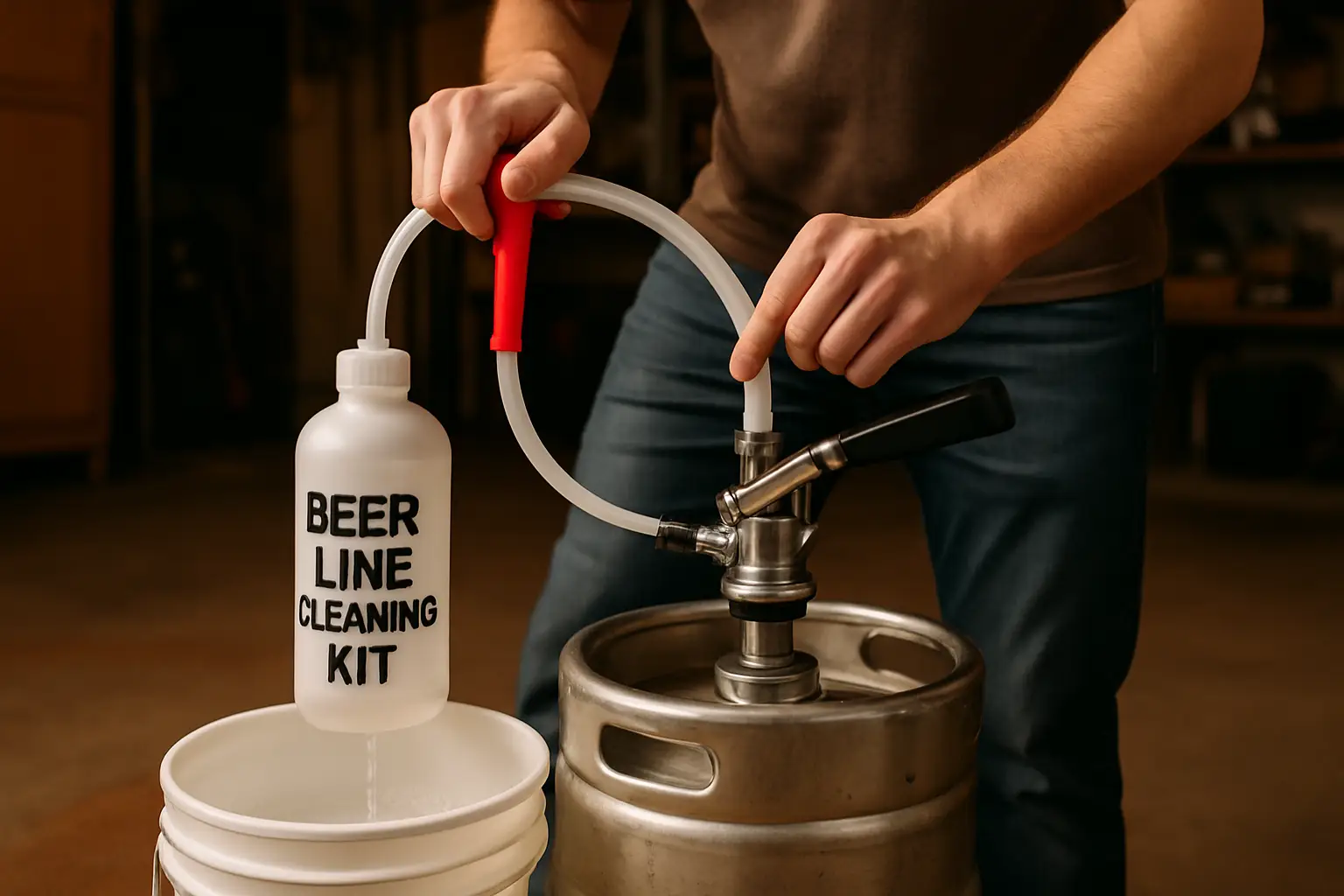
- Connect the cleaning kit. Attach the hand pump or pressurized cleaning bottle to the coupler’s beer-in port.
- Flush with cold water first. Push cold water through the line until it runs clear. This removes residual beer before the chemical cleaner contacts the line.
- Push alkaline cleaner through. Fill the cleaning vessel with the properly diluted alkaline solution and push it through the line. Allow it to soak for 15 minutes.
- Flush with cold water again. Push clean water through until no trace of cleaner remains. At minimum, flush with twice the volume of water compared to cleaner used.
- Perform an acid rinse (every 4 to 6 cleanings). Repeat the process using a diluted acid cleaner to remove beer stone. Flush thoroughly with water afterward.
- Scrub and rinse the faucet and coupler. Use brushes to clean interior surfaces, rinse with clean water, and allow to air dry or dry with a clean cloth.
- Reassemble and reconnect. Lubricate faucet seals, reinstall the faucet, reconnect the coupler to the keg, and restore CO2 pressure.
How Often Home Draft Lines Should Be Cleaned
The Brewers Association Draught Beer Quality Manual mandates that all draft beer systems be cleaned every two weeks, a standard cited widely by industry organizations including Micro Matic. While this standard was developed for commercial environments, it reflects sound microbiology and applies equally to home systems.
For home users who pour infrequently, a two-week interval may feel excessive. However, low-traffic lines actually accumulate biofilm faster relative to the volume poured. This occurs because the beer sits stagnant in the tubing for longer periods between pours. Therefore, a two-week maximum interval is a practical floor, not a ceiling.
The beer line cleaning kit market was valued at $859.6 million in 2025 and is projected to reach $910.3 million by the end of 2026, growing at a CAGR of 5.9% through 2036 (according to Future Market Insights, 2026). In addition, this growth reflects rising awareness of line maintenance across both commercial and home segments.
Things to Know When Cleaning Draft Beer Lines
- Alkaline alone is not enough. Alternating between alkaline and acid cleaners is necessary to remove both organic deposits and mineral scale. Moreover, using only one type leaves some contamination behind.
- Temperature matters. Cleaning solutions work best at temperatures between 70°F and 85°F. Cold solutions are less effective at breaking down organic residue.
- Beer stone is invisible. Calcium oxalate builds up inside lines without any visible warning. For example, if pours are consistently foamy or hazy even with a fresh keg, beer stone is likely the culprit.
- Faucet seals wear out. Routine cleaning is an opportunity to inspect O-rings and seals. Cracked seals allow air ingress, which causes oxidation and flat beer.
- Long-draw lines need a different approach. Systems with more than a few feet of tubing or a glycol beer system installation putnam county chiller require more advanced equipment and technique. Furthermore, readers interested in specialized setups should understand that cleaning those systems is equally advanced.
When Professional Cleaning Makes More Sense
Home systems with more than two taps, long-draw configurations, or systems that service events are outside the scope of a basic DIY cleaning. For those situations, working with a trained service provider ensures that lines, couplers, and regulators meet quality and safety standards.
Beer Line Cleaning USA serves bars, restaurants, breweries, and event operators across New York, New Jersey, and Connecticut, with a primary focus on Putnam County and the NYC metro area. Those planning an event in the region can consult the putnam county event draft support jockey box guide to understand what professional event draft support looks like. Businesses evaluating a full setup can also review commercial draft beer system installation questions putnam county for guidance on what to expect from a professional installation.
For ongoing system care in the region, professional support covers what routine maintenance includes and how it differs from DIY cleaning.
Keep Your Home Draft System Performing at Its Best
Understanding how to clean draft beer lines at home is the single most impactful maintenance habit a home draft owner can develop. Consistent two-week cleaning cycles protect the flavor of the beer, extend the life of the equipment, and eliminate health risks associated with microbial contamination in lines.
For home systems that have grown into multi-tap setups, or for anyone considering a more serious draft installation, professional service is a sound investment rather than an unnecessary expense.
Book a Professional Line Cleaning or System Review
A poorly maintained draft system wastes beer, damages equipment, and disappoints guests. Beer Line Cleaning USA provides expert cleaning, installation, and maintenance for draft systems of every size across the tri-state area. Request a free quote to get a professional assessment of your system and a clear plan for keeping it clean. Reach out today and let the team handle the maintenance so every pour is exactly what it should be.
Frequently Asked Questions
Q: What cleaning solution is safe to use in home draft beer lines?
Food-grade alkaline (caustic) cleaners are the standard choice for routine home line cleaning. Products specifically formulated for draft beer lines are available at homebrew supply stores and online retailers. Always verify that the product is food-safe and approved for contact with beverage tubing. Household bleach and general-purpose cleaners are not appropriate substitutes.
Q: Can dirty beer lines make someone sick?
Yes, contaminated draft lines can harbor harmful bacteria that pose a genuine health risk. Biofilm inside draft lines can host organisms such as Pediococcus and Lactobacillus, which cause spoilage, along with potentially harmful pathogens in severe cases. Regular cleaning is both a quality measure and a basic safety precaution.
Q: How long does it take to clean a home draft beer line?
A full cleaning cycle for a single-tap home kegerator typically takes 30 to 60 minutes from start to finish. This includes disassembly, flushing, soaking, rinsing, and reassembly. The soak time alone is usually 15 minutes. First-time users should plan for additional time to familiarize themselves with each step.
Q: Is it safe to drink beer right after cleaning the lines?
Only if the lines have been thoroughly flushed with cold water until no cleaning solution remains. Chemical carry-over is a real risk if rinsing is rushed. A practical test is to taste a small amount of the final rinse water. If it has any detectable odor or taste, continue flushing before reconnecting the keg.
Q: What happens if beer lines are never cleaned?
Uncleaned beer lines progressively degrade beer quality, produce off-flavors, and create conditions for microbial contamination. Over time, beer stone and biofilm buildup can become severe enough that the tubing must be replaced entirely rather than cleaned. At the commercial level, this carries significant cost. At home, it means wasted kegs and a degraded drinking experience that cleaning could have prevented entirely.