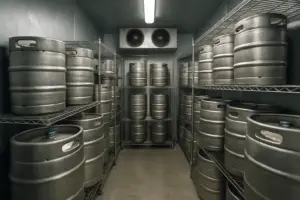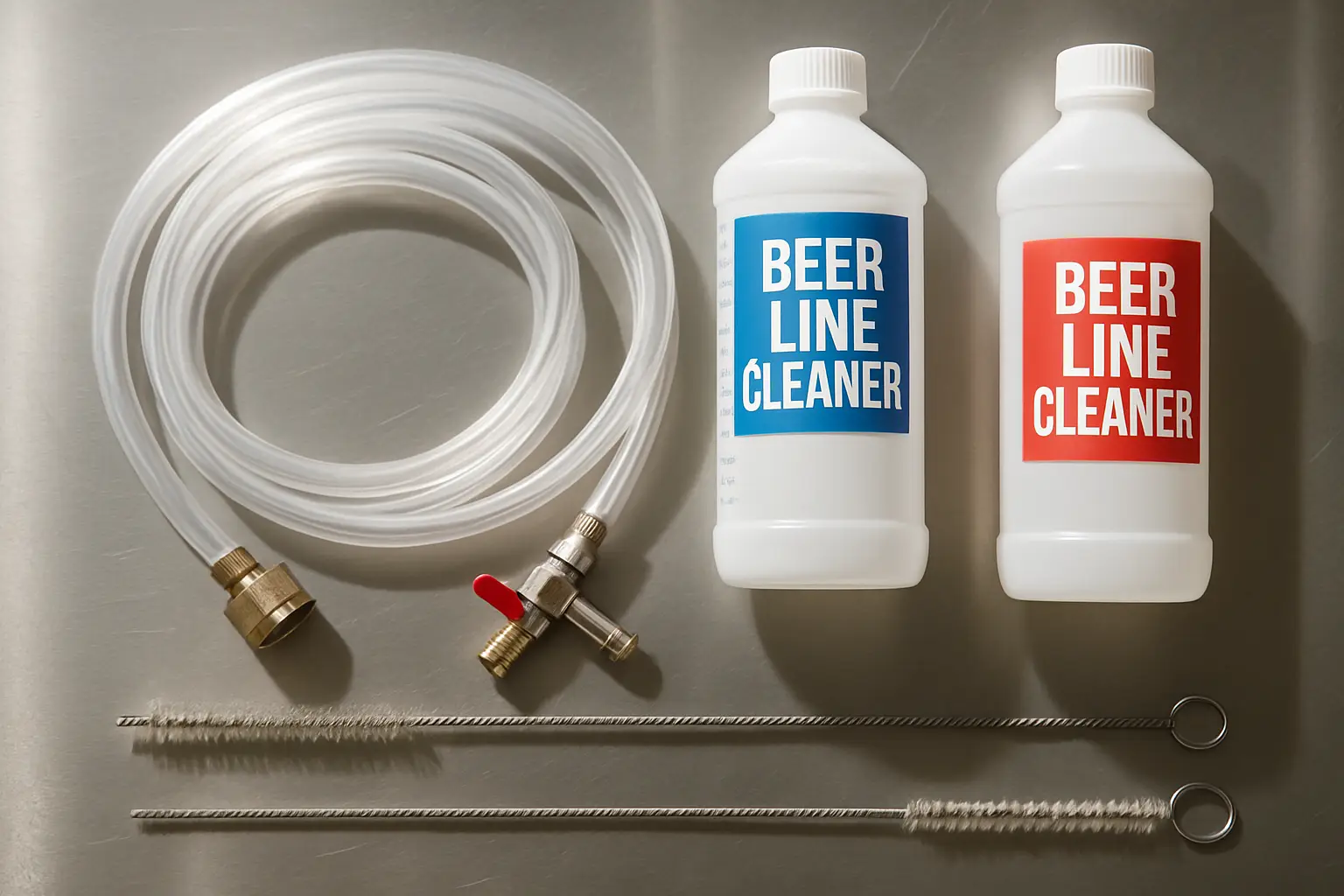
A beer line cleaning kit is a collection of tools and chemical solutions used to flush contaminants from draft beer lines, faucets, and couplers. Without regular cleaning, yeast, bacteria, mold, and beer stone accumulate inside lines and ruin the flavor, aroma, and safety of every pour. Understanding what a beer line cleaning kit contains helps you decide whether DIY cleaning suits your setup.
Table of Contents
- What Is Inside a Beer Line Cleaning Kit
- How Beer Line Cleaning Works Step by Step
- DIY Kit vs. Professional Beer Line Cleaning Kit Service
- Choosing the Right Beer Line Cleaning Kit for Your Setup
- Things to Know
Key Takeaways
- A beer line cleaning kit typically includes a hand pump or pressurized bottle, caustic or acid cleaner, a drip tray sanitizer, brushes, and tubing connectors.
- The Brewers Association recommends cleaning draft lines every two weeks for active systems.
- Chemical cleaners require specific contact time and dilution ratios to be effective and safe.
- DIY kits work for simple direct-draw setups but fall short on long-draw glycol systems and multi-tap bars.
- Beer Line Cleaning USA provides professional draft line cleaning and maintenance across Putnam County, Westchester, New York City, and the surrounding metro region.
- Skipping or rushing cleanings leads to off-flavors, foam problems, and potential health code violations.
What Is Inside a Beer Line Cleaning Kit
A standard beer line cleaning kit is designed to address every contact surface that draft beer touches between the keg and the glass. The core components typically found in commercial and retail kits include:
- Cleaning solution: Either an alkaline (caustic) cleaner for organic buildup like yeast and protein, or an acid cleaner for beer stone (calcium oxalate deposits). Some kits include both for a two-step process.
- Hand pump or pressurized cleaning bottle: Used to push the cleaning solution through the lines under controlled pressure.
- Keg coupler connector: A universal fitting that attaches the cleaning bottle directly to the draft line in place of the keg.
- Faucet brush and line brush: Small-diameter brushes for scrubbing the inside of faucets and the interior walls of vinyl or stainless tubing.
- Drip tray cleaner or sanitizer spray: Addresses bacteria colonies that build up in trays, which are often overlooked.
- Measuring cup or dilution guide: Accurate dilution is not optional. Under-diluted cleaner damages equipment; over-diluted cleaner fails to sanitize.
Moreover, some higher-end kits add a recirculating pump, pH test strips for verifying rinse neutrality, and replacement O-rings for faucets and couplers. These extras improve cleaning reliability for commercial operations.
How Beer Line Cleaning Works Step by Step
Understanding the cleaning process clarifies why each component in the beer line cleaning kit matters and where shortcuts cause problems.
1. Disconnect the keg and attach the cleaning coupler.
The cleaning bottle or hand pump connects to the same shank the keg normally occupies. This allows cleaning solution to travel the full path beer would normally take. Venues seeking draft beer system support putnam county should ensure their chosen service provider follows this standard protocol.
2. Flush the lines with clean water.
An initial water rinse pushes residual beer out of the lines before chemicals are introduced. Mixing beer directly with caustic cleaner reduces its effectiveness. This step prevents chemical waste and improves cleaning results.
3. Circulate the cleaning solution.
Alkaline cleaners typically require 15 to 20 minutes of contact time at the manufacturer’s specified dilution. The solution should sit in the lines, not just pass through. For recirculating systems, a pump cycles the fluid continuously to ensure even distribution.
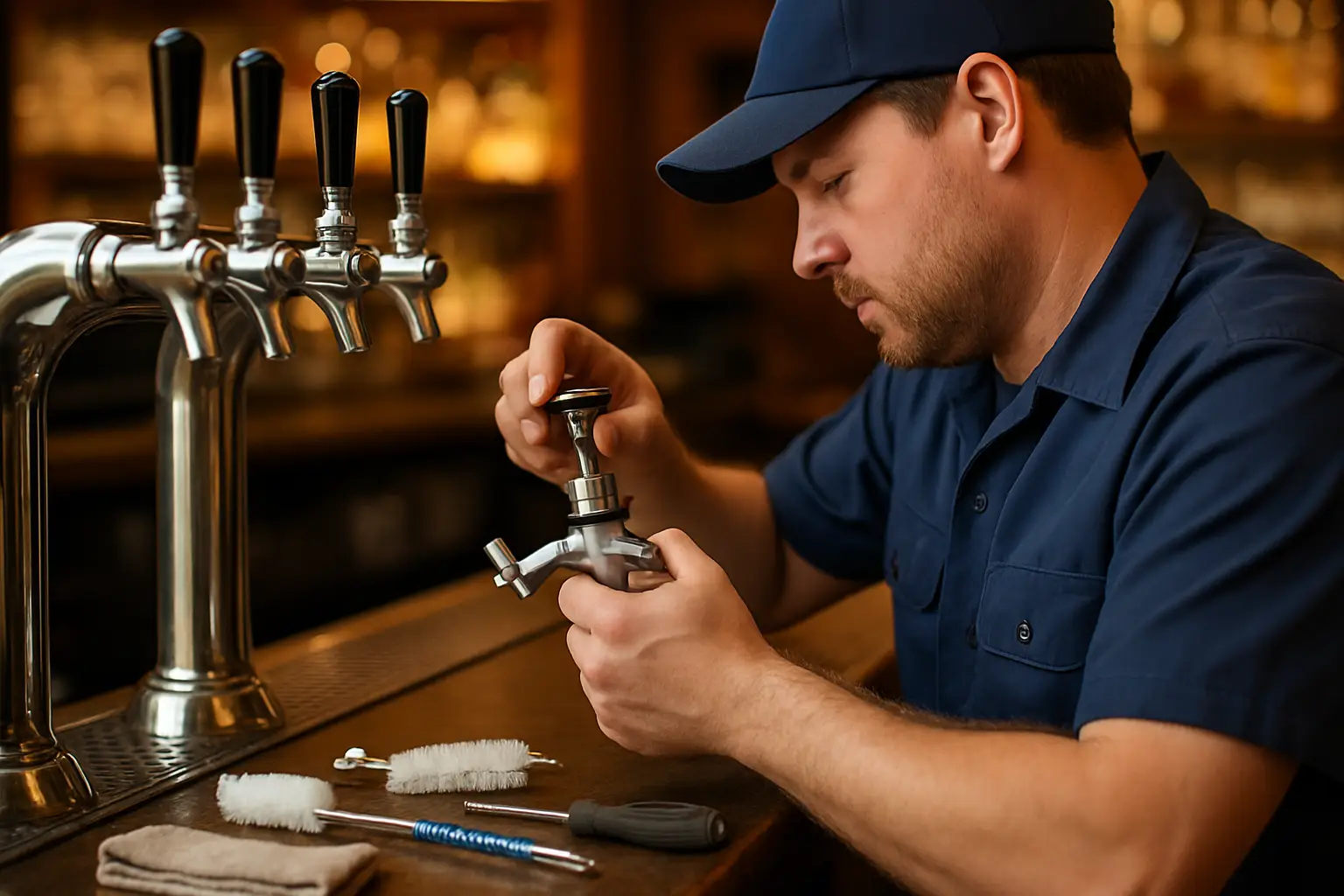
4. Brush faucets and couplers manually.
Faucets must be disassembled and scrubbed. Internal parts, especially the faucet seat and collar, harbor biofilm that chemical soaking alone does not fully remove. This hands-on step is critical for eliminating off-flavors.
5. Rinse thoroughly with clean water.
Residual caustic cleaner in lines will ruin the next pour and can cause consumer health issues. pH test strips confirm the rinse water is neutral before reconnecting a keg. Therefore, do not skip this verification step.
6. Optional acid rinse for beer stone.
High-volume accounts or systems that have gone longer between cleanings may need an acid step to dissolve beer stone that alkaline cleaners leave behind. Additionally, this step prevents mineral deposits from accumulating over time.
7. Reconnect the keg and check for foam or off-aromas on the first pour.
A clean line produces a clear, well-carbonated pour without sulfur, vinegar, or musty off-flavors. If problems persist, investigate further before serving customers.
DIY Kit vs. Professional Beer Line Cleaning Kit Service
A retail beer line cleaning kit costs roughly $30 to $80 and covers the basics for a home kegerator or a simple single-tap direct-draw setup. For bars, taprooms, and restaurants, the calculation changes significantly.
| Factor | DIY Kit | Professional Service |
|---|---|---|
| Upfront cost | $30–$80 per kit | Varies by tap count and frequency |
| Equipment coverage | Direct-draw, single-tap | Direct-draw and long-draw glycol |
| Chemical precision | User-dependent | Commercial-grade, controlled |
| Line inspection | Not included | Included |
| Compliance documentation | Not provided | Available upon request |
| Time required | 45–90 min per session | Handled by technician |
Long-draw glycol-cooled systems found in larger venues are not suitable for standard kit cleaning. These setups require specialized equipment and knowledge. In contrast, venues in the region that need glycol beer system installation putnam county or ongoing maintenance on a glycol trunk line should pursue professional service, not a retail kit.
Similarly, event operators who set up temporary draft systems should review the putnam county event draft support jockey box guide to understand what cleaning protocols apply to short-term jockey box setups before and after service.
Choosing the Right Beer Line Cleaning Kit for Your Setup
Not every kit is built for every system. Matching the beer line cleaning kit to the installation type prevents wasted effort and equipment damage.
Home kegerator owners need a basic hand-pump kit with a single-faucet brush, a coupler connector, and alkaline cleaner. Cleaning every two weeks (or at every keg change, if that is more frequent) keeps the system in good condition. This approach suits residential setups perfectly.
Single-tap bar or restaurant operators benefit from a pressurized cleaning bottle and a two-step chemical protocol. Frequency should follow the Brewers Association’s two-week guideline for active systems. Moreover, these venues may upgrade to professional service as volume increases.
Multi-tap commercial accounts require consistent professional service. Variables like line length, trunk line temperature, product rotation, and tap count make DIY cleaning inconsistent at best. Furthermore, operators with questions about their specific setup can review commercial draft beer system installation questions putnam county to understand how system design affects cleaning requirements.
Venues throughout Putnam County and the broader NYC metro area that need routine support should also look into ongoing draft beer system support putnam county to keep systems performing correctly between major service visits.
Things to Know
- Alkaline cleaners cannot remove beer stone on their own. Beer stone requires an acid cleaner, and skipping this step on older or neglected lines results in persistent off-flavors even after cleaning.
- Tap handles are a contamination point. Most kits do not include tap handle sanitizer, but handles are touched constantly and should be wiped down as part of every cleaning session.
- The two-week standard assumes regular, active use. Lines that sit idle for longer periods may require immediate cleaning before the next service regardless of when the last cleaning occurred.
- Rinse water temperature matters. Cold rinse water slows chemical neutralization and increases the risk of residual cleaner remaining in lines.
- Kit chemicals have shelf lives. Pre-mixed solutions degrade over time. Always check expiration dates and store concentrates away from heat and direct sunlight.
Make Your Draft System Work the Way It Should
Beer Line Cleaning USA provides professional draft line cleaning, system maintenance, equipment rental, and consulting for bars, restaurants, breweries, taprooms, hotels, and event operators across New York, New Jersey, and Connecticut, with a primary focus on Putnam County and the NYC metro area. Whether a venue needs a one-time deep clean or a recurring service schedule, the team handles the process with commercial-grade chemicals and trained technicians.
Request a free quote and let Beer Line Cleaning USA assess the system and recommend the right cleaning frequency and protocol. Contact the team today to schedule service and stop losing revenue to foamy, off-tasting pours.
Frequently Asked Questions
Q: How often should a beer line cleaning kit be used on an active tap system?
The Brewers Association recommends cleaning draft lines every two weeks for any system in regular use. This two-week interval prevents yeast, bacteria, and mold from establishing biofilm colonies inside the tubing. Systems that sit idle for extended periods should be cleaned before the next keg is tapped regardless of when the last cleaning occurred.
Q: Can a beer line cleaning kit handle a glycol long-draw system?
No, standard retail kits are not designed for glycol long-draw systems. Long-draw systems have trunk lines that can run dozens of feet, and cleaning them requires recirculating pumps and commercial-grade chemicals at precise temperatures. These systems need professional service to clean properly and safely.
Q: What is the difference between alkaline and acid beer line cleaners?
Alkaline cleaners remove organic deposits like yeast, protein, and mold, while acid cleaners dissolve beer stone, which is a mineral scale that alkaline products cannot break down. Many professional protocols use both in sequence. Alkaline cleaning addresses biological buildup first, and then an acid step removes the mineral deposits that remain.
Q: Is it safe to use a beer line cleaning kit without prior experience?
It is safe if the manufacturer’s dilution and safety instructions are followed exactly, but errors in dilution or rinsing can leave chemical residue in lines. Concentrated caustic cleaners are corrosive and require gloves, eye protection, and careful handling. First-time users should read all product safety data sheets before starting and never skip the final pH-verified rinse.
Q: Why does beer taste off even after cleaning with a kit?
Off-flavors after cleaning usually indicate incomplete rinsing, residual chemical in the lines, or contaminated faucet components that were not disassembled and scrubbed. Faucets must be fully disassembled and brushed during every cleaning session. If off-flavors persist after a thorough cleaning, the lines or faucet parts may need replacement, or beer stone buildup may require an acid cleaning step that was not included in the kit’s process.
The Bottom Line on Beer Line Cleaning Kits
A beer line cleaning kit is a practical starting point for home kegerator owners and single-tap operations running simple direct-draw systems. For commercial venues with multiple taps, long-draw infrastructure, or glycol cooling, a retail kit is not a substitute for professional service. The cost of inconsistent cleaning shows up in product waste, customer complaints, and potential health code exposure, not in the price of the kit itself. Therefore, operators who want consistently clean lines and reliable draft performance should treat professional cleaning as a standard operating cost, not an optional upgrade.