What’s In This Guide
- What Ongoing Support Actually Means for a Restaurant Draft System
- Why Post-Installation Support Matters for Restaurant Operations
- Best Practices for Maintaining a Restaurant Draft Beer System
- Common Mistakes Restaurants Make After Installation
- Provider Evaluation Checklist for Ongoing Draft System Support
- What Affects the Cost of Ongoing Draft System Support
- When to Bring In a Professional Draft System Provider
- Frequently Asked Questions
- Ready to Keep Your Restaurant’s Draft System Running Smoothly?
A new draft beer system for a restaurant rarely stays “new” for long. For any business relying on a draft beer system for restaurant operations, the initial setup is just the beginning. Once the installation crew leaves, the pressure regulators, glycol lines, faucets, and couplers become the operations team’s responsibility. That responsibility does not pause for a busy Friday night or a short-staffed week.
Many Putnam County restaurant owners assume that a properly installed system will run itself for months. In practice, commercial beer tap systems require scheduled attention almost immediately after startup, because temperature drift, gas pressure imbalance, and line buildup begin affecting pour quality long before a keg runs dry.
Quick Facts
- A newly installed draft beer system for a restaurant still needs a documented cleaning schedule.
- Temperature and pressure drift are common in the first weeks after installation, especially on long-draw or glycol-cooled setups.
- Restaurants without a maintenance log struggle to diagnose recurring foam, flat pours, or flavor complaints.
- Staff training on daily checks reduces avoidable service calls and protects the investment made in the original installation.
- Bringing in a professional provider for recurring inspections can help restaurants identify problems before they affect pour quality or lead to avoidable product waste.
What Ongoing Support Actually Means for a Restaurant Draft System
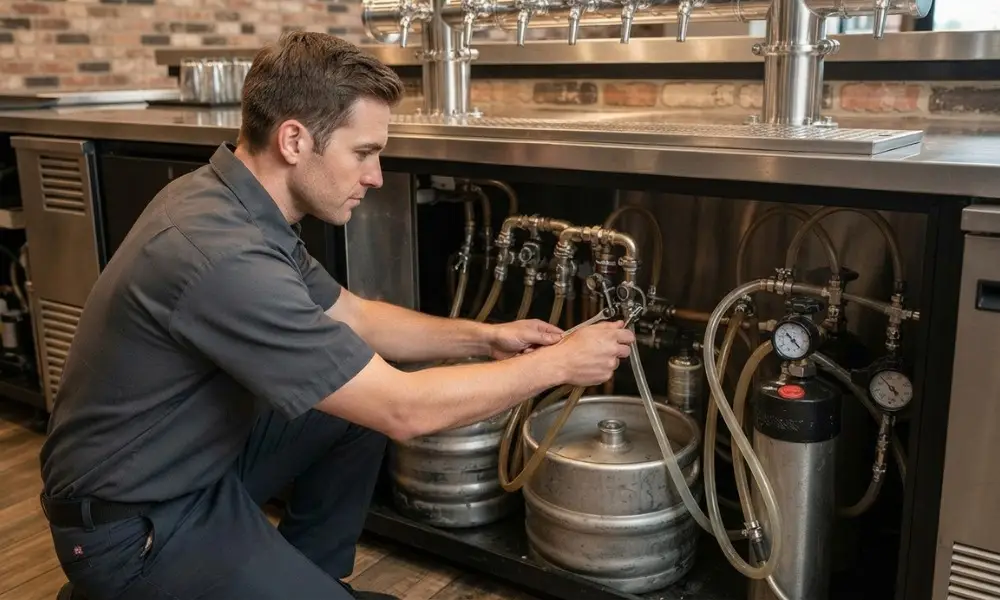
Ongoing support means scheduled cleaning, pressure and temperature checks, component inspections, and documentation completed according to a routine that continues after installation. It is not a single follow-up visit. It is a recurring operational task tied to how often the system is used.
Restaurant draft beer systems are dynamic. Keg-to-tap distance, beer style, service volume, and even the layout of a walk-in cooler all affect how quickly a system drifts out of balance. According to the Brewers Association, a balanced draught system depends on a consistent dispensing temperature between 38°F and 44°F, which means routine monitoring matters more than a one-time calibration during installation.
For restaurants, this translates into a few recurring responsibilities:
- Verifying beer and line temperature at set intervals
- Confirming applied CO2 or blended gas pressure matches the beer style and system length
- Cleaning lines, faucets, and couplers on a documented schedule
- Logging every check so patterns become visible over time
Why Post-Installation Support Matters for Restaurant Operations
Post-installation support for commercial bar tap systems protects the flavor consistency, guest experience, and equipment lifespan that the original installation was designed to deliver.
Guest Experience and Repeat Business
Draft beer quality is one of the more visible signals of operational care in a restaurant. A foamy pour or an off-flavor pint is easy for a guest to notice and report to a manager or, worse, mention in an online review. Restaurants that treat draft quality as an ongoing priority protect the guest experience the installation was meant to support.
Equipment Longevity
Buildup inside beer lines can affect flavor and restrict beer flow, while worn seals can contribute to leaks and inconsistent dispensing. Routine attention helps components operate properly and allows worn or damaged parts to be identified before they cause larger problems.
Operational Consistency Across Shifts
A restaurant draft system usually runs across multiple shifts, multiple bartenders, and sometimes multiple bar stations. Without a shared maintenance routine, one station may be dialed in while another quietly drifts out of balance, creating inconsistent pours that are hard to trace back to a single cause.
Best Practices for Maintaining a Restaurant Draft Beer System
A restaurant draft beer system holds up best when temperature, pressure, and cleanliness are checked on a fixed schedule rather than only when something seems wrong. Waiting for a visible problem usually means the issue has already been affecting pours for days or weeks.
Practical habits worth building into daily and weekly routines:
- Check liquid temperature. A thermometer reading in the glass or line gives a more accurate picture than trusting the refrigeration unit’s display.
- Watch the first pour of each shift. A consistently foamy first pour, followed by better subsequent pours, usually points to a warm tower or line segment rather than a keg issue.
- Standardize PSI settings by beer style and zone. Long-draw and short-draw lines, or different coolers, should be treated as separate systems rather than adjusted with a single blanket setting.
- Clean lines and components on a fixed interval. Brewers Association guidance recommends cleaning draught beer lines every two weeks, with additional cleaning when system conditions require it.
- Document every check. A simple log of temperature, PSI, and cleaning dates makes it far easier to spot trends before they become guest-facing problems.
READ MORE: How to Tell If Your Draft Beer Lines Are Dirty (7 Signs Bar Owners Miss)
Common Mistakes Restaurants Make After Installation
Restaurants most often run into trouble not because the original installation was flawed, but because ongoing maintenance was treated as optional. A few patterns show up repeatedly.
Assuming the System Runs Itself
Once a commercial beer tap system is installed and working well, it is easy to stop thinking about it. Beer lines, however, accumulate residue and biofilm regardless of how well the initial build was done. The Brewers Association Draught Beer Quality Manual notes that dispensing systems require consistent cleaning to prevent flavor-altering buildup from forming inside lines and components.
Reacting to Foam by Adjusting Pressure Alone
Staff under pressure during service often respond to foam by cranking the PSI up or down without confirming temperature first. This can mask the real issue temporarily while creating a new imbalance elsewhere in the system.
No Ownership of the Maintenance Schedule
When cleaning and checks are informally assigned to “whoever has time,” documentation gets skipped, and accountability disappears. Over time, this makes it difficult to know whether a flavor complaint is a one-time event or a sign of a deeper system issue.
Ignoring Zone Differences
Long-draw sections, glycol-cooled runs, and short direct-draw lines behave differently under the same PSI setting. Applying one setting across a mixed system is a common source of inconsistent pours between taps.
Provider Evaluation Checklist for Ongoing Draft System Support
Choosing a provider for ongoing draft system service affects consistency, documentation, and how quickly issues get resolved. A few factors are worth reviewing before committing to a maintenance partner.
|
Evaluation Factor |
Why It Matters |
|
Documented cleaning process |
Confirms the provider follows a repeatable, verifiable routine rather than a quick rinse. |
|
Component-level service |
Covers faucets, couplers, shanks, and FOB devices. |
|
Response time for service calls |
Affects how quickly foam, leaks, or pressure issues are addressed during business hours. |
|
Familiarity with long-draw and glycol systems |
Relevant for restaurants with cooler-to-bar distances beyond a direct-draw setup. |
|
Scheduling consistency |
Supports a documented maintenance history rather than irregular, reactive visits. |
Restaurants working with a provider familiar with the original commercial draft beer system installation often find it easier to maintain continuity, since the same team understands the system’s layout, gas configuration, and line lengths from the start.
What Affects the Cost of Ongoing Draft System Support
Ongoing service costs for a restaurant draft beer system vary based on the number of taps, system type, service frequency, and the complexity of the original build. There is no single flat rate that applies evenly across every restaurant.
Factors that typically influence an estimate include:
- Number of taps and lines being serviced
- Direct-draw versus long-draw or glycol-cooled configuration
- Frequency of cleaning and inspection visits
- Site accessibility, including walk-in cooler layout and line routing
- Whether repairs, part replacement, or troubleshooting are needed alongside routine service
- Scheduling needs, including after-hours or emergency visits
Because every restaurant’s setup and service history is different, the most accurate way to understand ongoing support costs is a direct conversation about the specific system in place.
When to Bring In a Professional Draft System Provider
A professional provider is worth bringing in when foam or flavor issues persist after temperature and pressure have been checked, when a system includes long-draw or glycol components, or when documentation has lapsed and the maintenance history is unclear.
Signs that point toward professional support include:
- One tap consistently underperforms compared to others on the same system
- Cleaning has become inconsistent or undocumented over recent months
- Staff are frequently adjusting PSI without lasting improvement
- The restaurant recently changed beer styles, tap count, or line configuration
- No one on staff has a clear record of the last cleaning or inspection date
A trained technician can test the system end to end rather than isolating one variable at a time, which can help identify recurring issues faster than in-house troubleshooting alone.
Frequently Asked Questions
How soon after installation should a restaurant schedule its first maintenance check?
Most systems benefit from an early follow-up within the first few weeks of operation, since new installations can still need minor pressure or temperature adjustments as staff settles into daily service patterns. Waiting several months before the first check often means small issues go unnoticed longer than necessary.
Does a restaurant’s beer selection affect how often the system needs service?
Yes. Different beer styles have different carbonation levels and dispensing requirements, and systems serving a wide rotation of styles may need more frequent pressure checks than a restaurant with a stable, limited draft list. Each beer should be dispensed according to its carbonation level, temperature requirements, and recommended applied pressure.
Can restaurant staff handle draft system maintenance without professional help?
Basic daily checks, like watching the first pour or logging cooler temperature, can be handled by trained staff. Deeper cleaning, component disassembly, and pressure calibration typically benefit from professional equipment and experience, especially on long-draw or glycol-cooled systems.
What is the biggest sign that a restaurant’s draft system needs professional attention?
Persistent foam or flat pours that continue after temperature and PSI have already been checked usually point to a deeper issue, such as restriction, dirty lines, or a failing component. This is generally the clearest signal that professional troubleshooting is needed.
How does documentation help with ongoing draft system support?
A maintenance log showing cleaning dates, temperature readings, and PSI settings makes it much easier for a technician or manager to identify patterns and pinpoint the source of a recurring issue. Without documentation, troubleshooting often becomes guesswork rather than a targeted fix.
Ready to Keep Your Restaurant’s Draft System Running Smoothly?
Beer Line Cleaning USA supports Putnam County restaurants beyond the initial installation, helping operators maintain consistent pours through scheduled cleaning, inspections, and system checks. The team behind the original build understands the system’s layout, gas configuration, line lengths, and service requirements.
If a recent installation needs a maintenance plan or an existing system has started showing signs of foam, flat pours, or flavor drift, professional support can help restore consistency before guests notice.