Knowing how to change a keg is essential for any bar, restaurant, or venue serving draft beer. The process involves safely disconnecting the empty keg, connecting the new one, purging air from the line, and verifying pressure before serving. When done correctly, a keg change takes under five minutes and keeps beer quality consistent from the first pour of every fresh keg.
Key Takeaways
- Always release line pressure before disconnecting a coupler to avoid beer spray and potential injury.
- The coupler must be fully seated and locked before gas is reintroduced to the new keg.
- After tapping a new keg, allow 10-15 minutes of rest before serving to let foam settle.
- CO2 pressure, temperature, and line length are all interconnected; changing one affects the others.
- A foamy first pour after a keg change usually signals a pressure issue, not a bad keg.
- Regular draft line cleaning and system maintenance are just as important as proper keg-changing technique.
What You Need Before You Change a Keg
Before touching the coupler, having the right tools and conditions in place prevents most problems that plague keg changes in commercial settings. A rushed or poorly prepared swap causes foamy beer, wasted product, and unnecessary wear on equipment.
Equipment checklist:
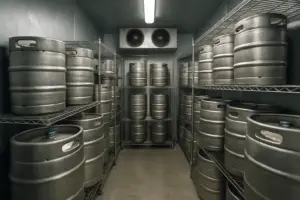
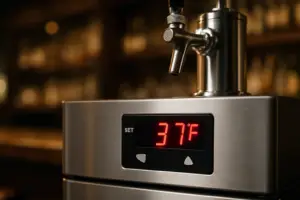
- A fresh, properly chilled keg (ideally at 36-40°F for at least 24 hours before tapping)
- The correct coupler type for the keg (D-system, S-system, A-system, etc.)
- A CO2 or mixed gas tank with enough pressure (typically 10-14 PSI for most American lagers and ales)
- A keg wrench if needed for older equipment
- Clean, dry towels for wiping down connections
- A flashlight if the keg is stored in a dark cooler
One detail that often catches operators off guard is coupler compatibility. The Brewers Association’s Draught Beer Quality Manual explains that kegs may use different valve and coupler systems, with most U.S. breweries relying on the Sankey “D” coupler. Using the wrong coupler is more than an inconvenience; it can damage the keg valve. Always confirm the required coupler type before the keg arrives.
The FDA Food Code recommends cold-holding time or temperature control for safety foods at 41°F or below. For draft beer quality, the Brewers Association recommends keeping kegs cold throughout distribution and storage and properly chilled before service.
How to Change a Keg: The Full Step-by-Step Process
Step 1: Shut Off the Gas Supply When You Change a Keg
Before anything else, close the gas shutoff valve on the CO2 or nitrogen tank. This prevents pressure from continuing to push through the line while you work. In a multi-tap system, trace the gas line to the specific coupler being changed. Additionally, close only that branch if a secondary shutoff is available.
Step 2: Release Pressure from the Coupler
Most couplers have a pressure relief valve, often a small ring or lever on the top. Pull it gently to bleed residual pressure from the coupler and beer line. You will hear a short hiss as pressure escapes. Skipping this step is the number one cause of beer spray during keg changes. This creates both a mess and a slip hazard.
Step 3: Disconnect the Coupler from the Empty Keg
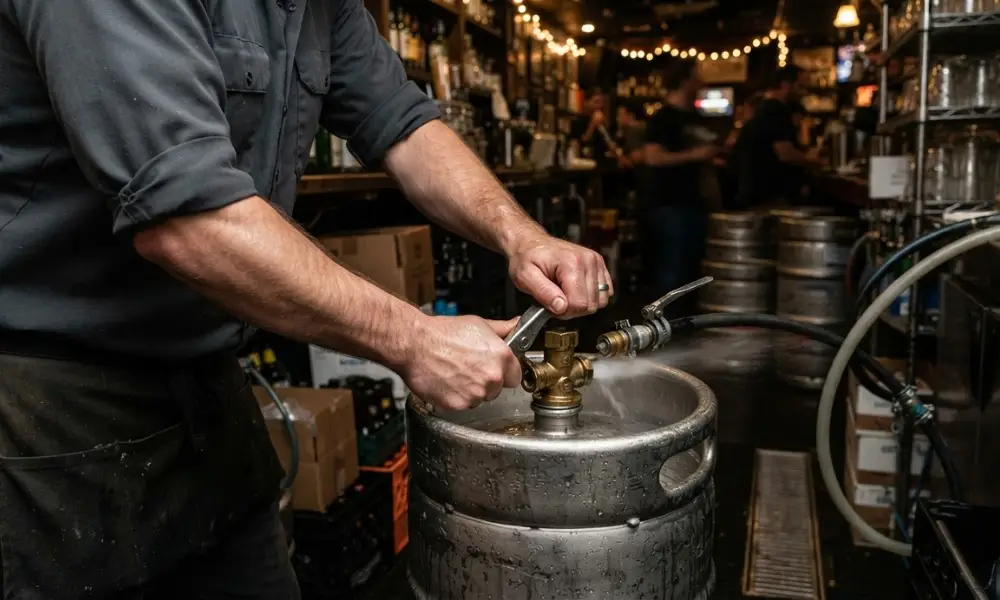
Turn the coupler handle to the “off” or “open” position, then rotate the entire coupler counterclockwise to disengage it from the keg’s valve stem. Lift it straight up and set it aside on a clean surface. Do not drag the coupler across the floor or drop it. The internal O-rings can shift or crack, leading to leaks on the next connection.
Step 4: Inspect the Coupler Before Reconnecting
Check the O-ring inside the coupler body. It should be soft, round, and fully seated in its groove. A flat, cracked, or missing O-ring is a guaranteed leak. A leaking CO2 line in an enclosed cooler can displace oxygen and create a hazard.
Step 5: Position and Tap the New Keg
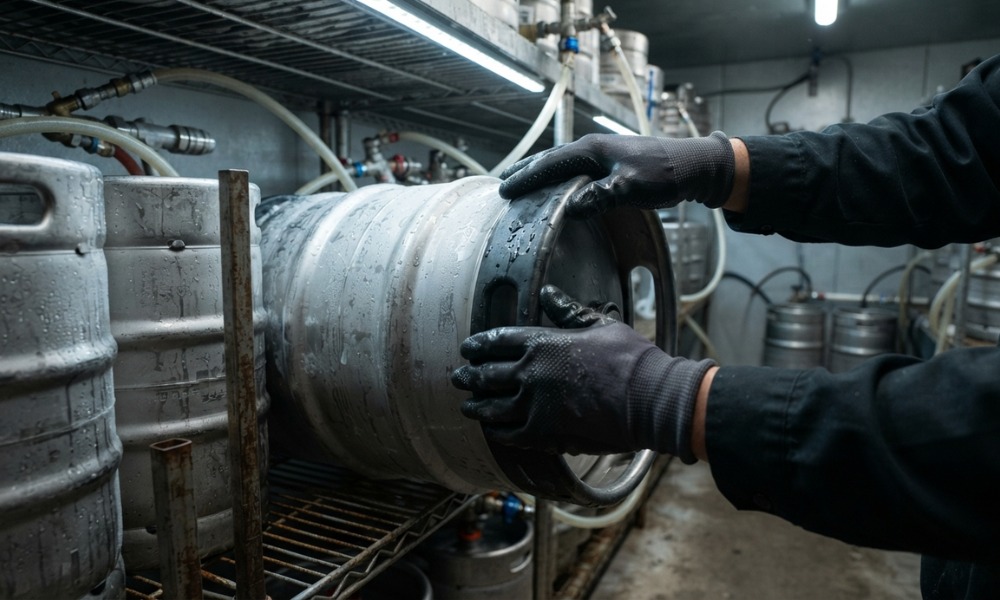
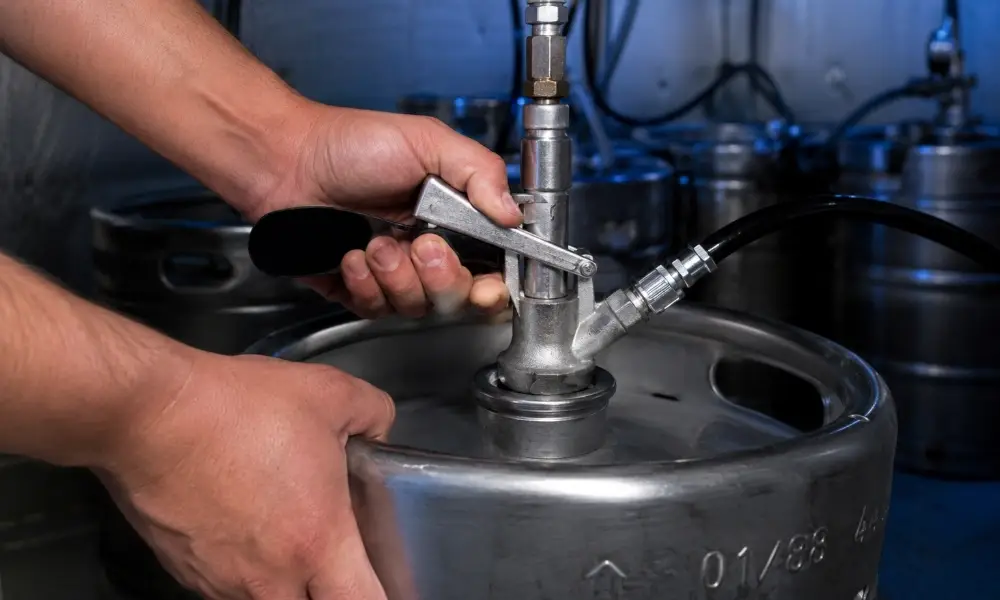
Move the empty keg out and position the new keg in its place. Remove the dust cap or plastic seal from the new keg’s valve stem. Align the coupler with the valve, press it down firmly, and rotate clockwise until it locks into place. The coupler should sit flush with no wobble.
Step 6: Turn the Coupler Handle to the “On” Position
Engage the coupler by pushing the handle down and turning it to the “on” or “serve” position. This opens the keg valve and allows beer to flow into the line.
Step 7: Restore Gas Pressure When You Change a Keg
Open the gas shutoff valve slowly. Watch the in-line pressure gauge return to your target PSI. For most standard American draft setups, that is between 10 and 14 PSI at 38°F, but longer draw systems, mixed gas setups, and high-carbonation craft beers may require different pressures. If you are operating a glycol beer system installation in Putnam County that uses glycol-cooled long-draw technology, the pressure calculus changes significantly and the team at Beer Line Cleaning USA can confirm the correct pressure settings for your specific line length and beer variety.
Step 8: Allow the Keg to Rest, Then Pull a Test Pour
Wait 10-15 minutes before pulling the first pour. This allows CO2 to re-equalize in the beer after the disturbance of tapping. Pull a short test pour into a drain glass. The first ounce or two may be foamy, which is normal. If foam persists beyond a full pint, check pressure settings and line temperature before serving to customers.
Common Problems After You Change a Keg (and How to Fix Them)
Even experienced bar staff encounter issues after a swap. Here are the most frequent problems and their likely causes:
| Problem | Most Likely Cause | Fix |
|---|---|---|
| Excessive foam immediately after tapping | Keg not cold enough or pressure too high | Check keg temp (36-40°F) and reduce PSI by 1-2 |
| No beer flow at all | Gas turned off or coupler not fully engaged | Confirm gas valve open; reseat coupler |
| Slow, flat pour | Pressure too low or kinked line | Increase PSI incrementally; inspect lines |
| Leak at coupler connection | Worn or missing O-ring | Replace O-ring before retapping |
| Beer tastes off even from a new keg | Dirty beer lines | Schedule a draft line cleaning |
When Changing a Keg Gets More Complicated
For standard single-tap direct-draw systems, a keg change is quick and low-risk. But in commercial environments with longer draw systems, multiple taps, glycol cooling, or high-volume event setups, the process involves more variables.
Long-draw systems running 25 feet or more require balanced pressure calculations. These calculations account for line resistance, elevation changes, and beer carbonation levels. If pressure has drifted or lines have not been cleaned recently, a keg change alone will not resolve pour quality problems. Venues and operators with complex systems benefit from working with professionals who understand these systems end to end. Beer Line Cleaning USA provides comprehensive draft beer system support in Putnam County for exactly these situations, from routine keg-change guidance to full system diagnostics.
For events specifically, jockey box setups introduce their own set of keg-change considerations. This particularly applies to maintaining cold temperatures without a walk-in cooler. The Putnam County event draft support jockey box guide covers the equipment and process in detail for anyone running beer service at outdoor events, festivals, or private gatherings.
Things to Know About Changing a Keg
- Keg sizes vary: a half-barrel (standard U.S. keg) holds 15.5 gallons, a quarter-barrel holds 7.75 gallons, and a sixth-barrel holds 5.16 gallons. Knowing your keg type affects how long each one lasts and how you plan restocking.
- Not all couplers are universal. There are at least eight coupler types used globally. Using the wrong one can damage the keg valve and void supplier agreements.
- A brand-new keg that has been recently transported should rest for at least an hour before tapping. Rest longer if it was jostled significantly.
- CO2 tanks can run low without obvious signs. Build a refill schedule based on keg volume rather than waiting for pressure drops during service.
- If your system uses a mixed gas blend (CO2 and nitrogen), do not substitute with pure CO2. This will over-carbonate nitrogenated beers like stouts and porters.
- Any operator installing or expanding their draft setup should review commercial draft beer system installation questions in Putnam county before making equipment decisions, since system design affects every keg change going forward.
Keep Your Draft System Optimized After Every Keg Change
Consistent pour quality depends on more than knowing how to change a keg. It requires a system that is clean, properly pressurized, and maintained on a regular schedule. Beer Line Cleaning USA, founded in 2021 and serving bars, restaurants, breweries, taprooms, and venues across New York, New Jersey, and Connecticut, offers draft line cleaning, system installation, equipment rental, and ongoing maintenance for commercial beverage operations throughout the Putnam County and NYC metro region.
The team at Beer Line Cleaning USA brings over 20 years of combined experience to every service call, whether that is a routine cleaning visit, a pressure calibration, or a full glycol system installation. Operators who invest in regular professional service spend less time troubleshooting and more time serving beer that tastes the way it should.
Build a Consistent Keg-Change and Maintenance Routine for Your Operation
Reach out to Beer Line Cleaning USA to schedule a system evaluation, line cleaning, or equipment rental for your next event. A clean, balanced draft system makes every keg change faster and every pour better. Call us or book a draft system consultation with the team today.
Frequently Asked Questions
Q: How often should a keg be changed relative to draft line cleaning?
Draft lines should be cleaned every two weeks regardless of how many kegs are cycled through.
The frequency of keg changes does not replace the need for scheduled line cleaning. Even high-volume accounts that go through multiple kegs per week need biweekly cleaning to prevent yeast and bacteria buildup inside the lines.
Q: Why is there so much foam after changing a keg?
Foam after a keg change almost always comes from a warm keg, excessive pressure, or CO2 agitation during the swap.
Allow the keg to rest for 10-15 minutes after tapping before pulling a pour. If foam persists, check that the keg has been refrigerated for at least 24 hours and that PSI is within the correct range for that beer style.
Q: Can you tap a keg without a CO2 tank using a hand pump?
A hand pump can tap a keg temporarily, but it introduces oxygen that will stale the beer within 24 hours.
Hand pumps are appropriate for short-duration use at parties or events where the keg will be finished the same day. For any commercial setting, CO2 or mixed gas is required to maintain beer quality across multiple service periods.
Q: What happens if the coupler O-ring fails during service?
A failed O-ring causes a gas or beer leak at the connection point, leading to pressure loss, foam, and potential CO2 buildup in an enclosed space.
Replacing O-rings is inexpensive and takes under two minutes. Keeping a small stock of replacement O-rings behind the bar is standard practice in high-volume venues.
Q: How do you know when a keg is truly empty versus just temporarily out of pressure?
A keg is empty when the pour produces only foam or gas regardless of pressure adjustments.
When pressure is correct and the line is clean but only foam comes out, the keg is empty. If uncertain, disconnect and physically tilt the keg. An empty keg is noticeably lighter and will have no liquid sloshing inside.
The Bottom Line on How to Change a Keg
Knowing how to change a keg correctly is a foundational skill for anyone running a commercial draft operation, but it is only one piece of a larger system that needs consistent attention. Proper keg temperature, coupler condition, line cleanliness, and pressure calibration all contribute to whether that first pour from a fresh keg tastes the way it should.