Table of Contents
- Why Force Carbonation Is Worth Understanding
- Equipment You Need Before Starting
- The Two Main Force Carbonation Methods
- Pressure and Temperature: The Variables That Matter Most
- Things to Know
- Keeping Your Draft System Clean After Carbonation
Key Takeaways
- Force carbonating in a keg is faster than bottle conditioning and produces consistent, predictable results.
- Temperature and pressure are the two controlling variables — get either wrong and the carbonation will be off.
- The “set and forget” method takes 5 to 14 days but is the most reliable for homebrewers.
- Burst carbonation works in 24 to 48 hours but requires monitoring to avoid over-carbonation.
- A 2016 Brülosophy exBEERiment with 15 participants found tasters could not reliably distinguish force carbonated beer from naturally conditioned beer.
- Draft line hygiene matters just as much as carbonation — dirty lines ruin even perfectly carbonated beer.
Why Force Carbonation Is Worth Understanding
Homebrewing and small-scale kegging have grown significantly in recent years. According to Verified Market Research (2024), the home beer brewing kits market was valued at USD 20.61 billion in 2024 and is projected to reach USD 26.11 billion by 2032, growing at a 3.1% compound annual growth rate. That growth means more brewers are moving from bottles to kegs, and force carbonation sits at the center of that transition.
The practical appeal is straightforward. Bottle conditioning requires adding priming sugar, waiting two to four weeks, and accepting some batch-to-batch variability. Kegging with forced CO₂ compresses that timeline considerably and gives the brewer direct control over carbonation levels. University of Florida extension materials note that forced carbonation pumps pressurized CO₂ into a sealed vessel, allowing the gas to dissolve into the liquid under controlled conditions — a cleaner and more adjustable process than relying on residual yeast activity.
Equipment You Need Before Starting
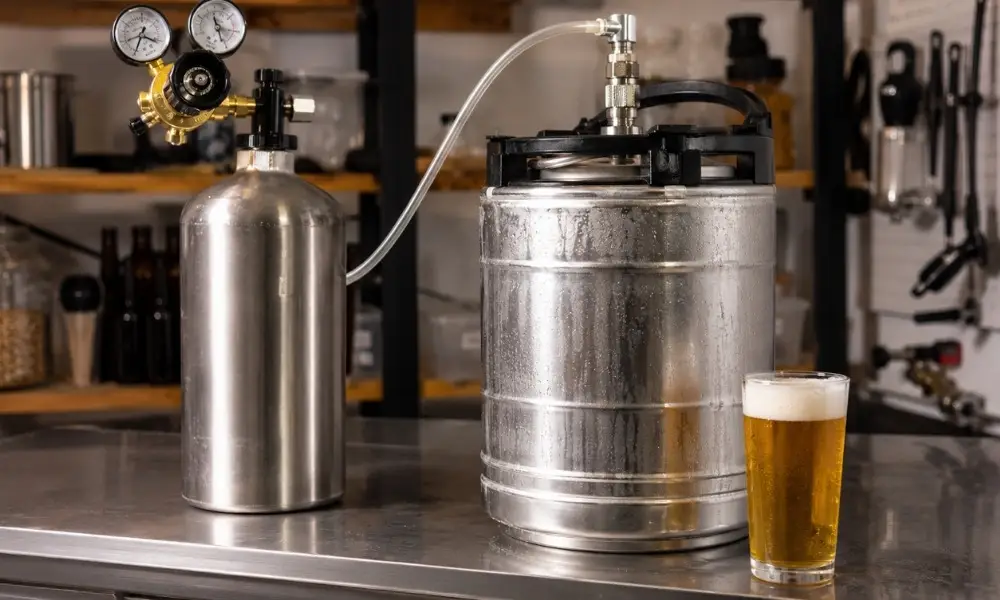
Before attempting to force carbonate beer in a keg, having the right setup is non-negotiable. Improvising around missing components leads to leaks, inconsistent carbonation, or wasted CO₂.
Core equipment checklist:
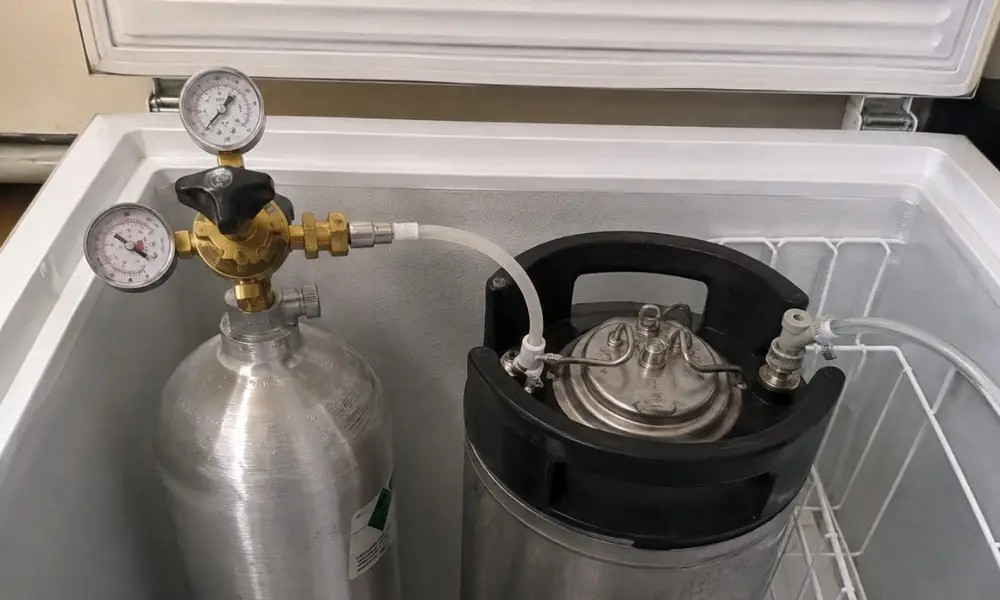
- A ball-lock or pin-lock Cornelius keg (5-gallon is the most common size for homebrewers)
- A CO₂ tank (5 lb or 10 lb is practical for most home setups)
- A dual-gauge regulator to monitor tank pressure and output pressure separately
- Gas-in and liquid-out disconnects matched to your keg type
- Food-grade CO₂-rated tubing
- A kegerator or chest freezer to maintain consistent cold temperatures
According to resources at Homebrew Finds, CO₂ consumption during force carbonation varies by method and temperature, but a 5 lb tank typically handles multiple kegs before needing a refill. Knowing your approximate CO₂ usage helps avoid running dry mid-carbonation.
The Two Main Force Carbonation Methods
Set and Forget (Slow Carbonation)
This is the most hands-off and consistently reliable method. The keg is chilled to 34 to 38°F, connected to CO₂ at the correct serving pressure for the target carbonation level, and left sealed for 5 to 14 days. The CO₂ slowly dissolves into the cold beer without any agitation.
The keg force carbonation tool at Beer and Brewing helps calculate the precise pressure needed based on beer temperature and desired volumes of CO₂. For a standard American lager or pale ale targeting around 2.5 volumes of CO₂ at 38°F, the regulator is typically set somewhere in the 10 to 12 PSI range. Different beer styles require different carbonation levels — Belgian ales and wheat beers often target higher volumes, while English cask-style ales sit lower.
Pros of set and forget:
- Minimal risk of over-carbonation
- Consistent results across batches
- No monitoring required once set
Cons:
- Requires patience — not suitable if the beer is needed quickly
Burst Carbonation (Fast Method)
When time is short, burst carbonation raises the CO₂ pressure to 30 to 40 PSI for 24 to 48 hours. Some brewers also roll or gently rock the keg to accelerate gas absorption. Once the target carbonation level is reached, the pressure is reduced to serving pressure and the beer is vented slowly to bleed off excess CO₂.
KegLand’s step-by-step carbonation resource covers both approaches in detail, noting that the agitation method can carbonate beer in as little as an hour — though precision is harder to control and over-carbonation is a real risk if the beer line cleaning process is not monitored carefully.
Pros of burst carbonation:
- Fast — beer can be ready to pour in 24 to 48 hours
- Useful for events or time-sensitive batches
Cons:
- Higher risk of over-carbonation
- Requires more active monitoring
Pressure and Temperature: The Variables That Matter Most
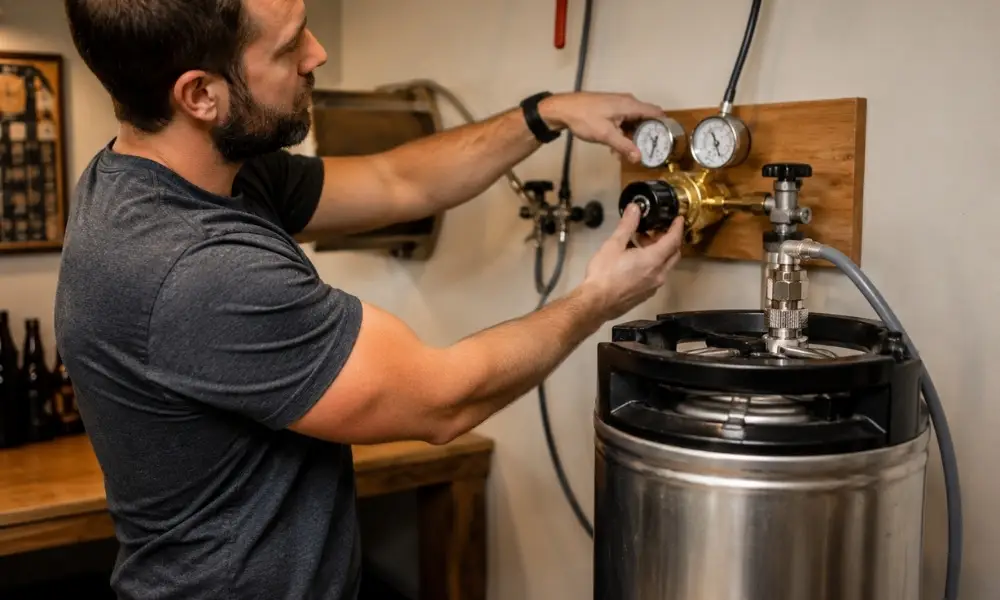
Carbonation is a function of two variables: temperature and pressure. Colder beer absorbs CO₂ more efficiently, which means a keg at 34°F requires less pressure to reach the same carbonation level as a keg at 50°F. Failing to chill the keg before carbonating is one of the most common mistakes homebrewers make.
The carbonation priming chart at Brew Your Own provides a reference for CO₂ volumes by beer style, which translates directly into the pressure settings needed when kegging. Cross-referencing desired volumes against beer temperature gives a precise PSI target.
A practical rule: always chill the keg to serving temperature before connecting CO₂. Room-temperature carbonation is inefficient, wastes gas, and increases the risk of miscalibrating the final result.
Things to Know
- Purge oxygen before carbonating. Residual oxygen in the keg oxidizes the beer. Purge with CO₂ before transferring beer, and again after sealing.
- Check for leaks every session. A leaking keg connection will bleed off pressure and stall carbonation. Use Star San solution around fittings and watch for bubbles.
- Beer style dictates carbonation target. A dry stout targets around 1.5 to 2.0 volumes; a hefeweizen may target 3.5 to 4.5 volumes. Using a flat pressure for every style leads to under- or over-carbonated pours.
- Burst carbonation is temperature-sensitive. Running high pressure at warm temperatures risks extreme over-carbonation. Always chill first.
- Line length and diameter affect pour quality. Even perfectly carbonated beer will foam if the serving line is too short or the wrong diameter.
Keeping Your Draft System Clean After Carbonation
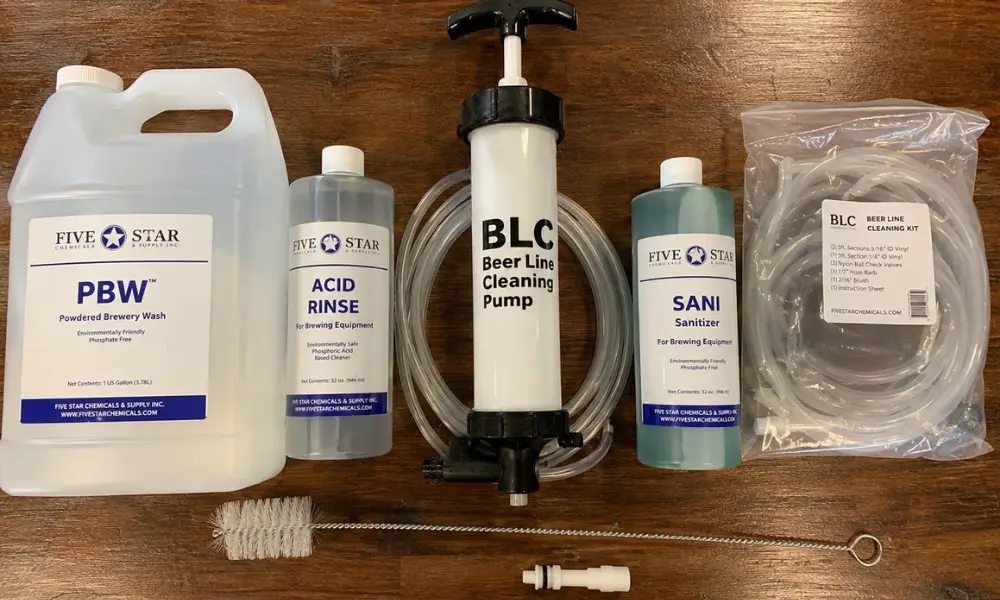
Getting carbonation right is only half the equation. Dirty draft lines introduce off-flavors, microbial contamination, and pour issues that no amount of precise CO₂ dialing will fix. The proper approach involves using appropriate beer line cleaning chemicals that should be performed at least every two weeks on any active tap, following industry standards.
A dedicated beer line cleaning kit simplifies the process considerably for most home setups. Those unsure about the fundamentals can find detailed guidance on how to clean draft beer lines at home, which walks through the full flushing and rinsing sequence step by step.
Dial In Your Draft Setup With Expert Help
Beer Line Cleaning USA supports bars, taprooms, breweries, and restaurants across New York, New Jersey, and Connecticut with professional draft system cleaning, maintenance, and consulting. If your system is not performing at its best, request a free consultation to get an expert assessment of your setup. Reach out today and get specific recommendations for your keg system, line configuration, and cleaning schedule.
Frequently Asked Questions
Q: How long does it take to force carbonate a keg?
The set-and-forget method takes 5 to 14 days; burst carbonation with agitation can work in 24 to 48 hours.
The timeline depends heavily on CO₂ pressure, beer temperature, and whether the keg is agitated. Colder beer carbonates more efficiently, so chilling the keg to 34 to 38°F before starting speeds up the process regardless of which method is used.
Q: What PSI should I use to force carbonate beer?
Typical set-and-forget carbonation uses 10 to 14 PSI at 38°F for most ales and lagers, though the exact figure depends on the target CO₂ volume.
Using a carbonation chart cross-referenced with beer temperature and desired volumes gives a precise pressure setting. Running pressure too high risks over-carbonation; too low results in flat beer even after extended wait times.
Q: Can force carbonated beer taste different from naturally conditioned beer?
Research suggests most drinkers cannot tell the difference in a blind triangle test.
A 2016 Brülosophy exBEERiment involving 15 participants found that tasters were unable to reliably distinguish force carbonated beer from keg-conditioned beer in an IPA. While the sample size is small, it aligns with the practical experience of most homebrewers and commercial kegging operations.
Q: Do I need to purge oxygen from the keg before carbonating?
Yes, purging oxygen is essential to prevent oxidation, which causes stale, cardboard-like off-flavors.
To purge, connect CO₂ to the gas-in post, pressurize to around 10 PSI, then pull the pressure relief valve to vent. Repeat this two to three times before transferring beer into the keg.
Q: How often should draft lines be cleaned on a home kegerator?
Industry standards recommend cleaning draft lines at least every two weeks on any active tap.
Even low-traffic home setups are not exempt from microbial buildup. Yeast, bacteria, and mold can colonize lines quickly, affecting both flavor and pour quality. A proper cleaning kit and the correct cleaning chemicals are sufficient for most home systems.
The Bottom Line on How to Force Carbonate Beer in a Keg
Knowing how to force carbonate beer in a keg gives any brewer direct control over one of the most important variables in the finished product. Whether the goal is a quick turnaround for an event or dialing in a consistent process for regular batches, the fundamentals come down to temperature, pressure, and time. Get those three variables right, and the results are repeatable and reliable.
Clean lines and a well-maintained draft system are equally important to making sure that carefully carbonated beer reaches the glass as intended. Homebrewers and commercial operators alike benefit from treating system hygiene with the same rigor as carbonation calibration.