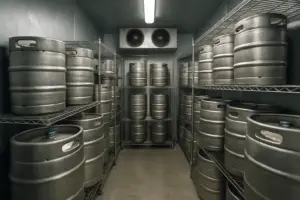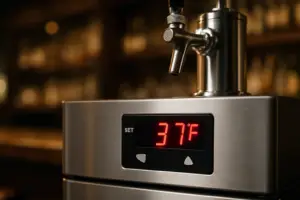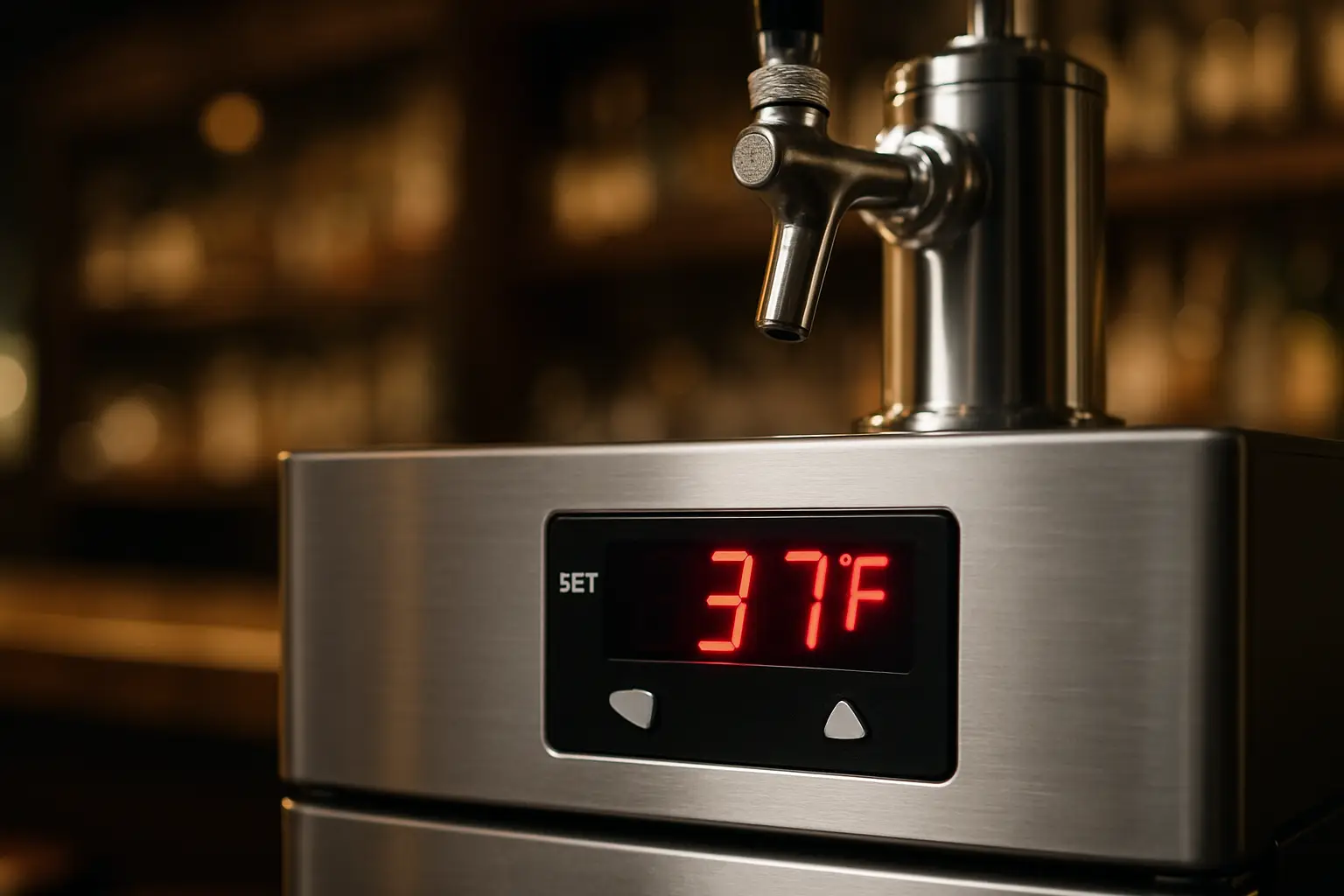
Getting your kegerator temperature setting right is essential for draft beer quality. The ideal kegerator temperature setting falls between 36°F and 38°F for most American lagers and draft beers. This range preserves carbonation, prevents foamy pours, and protects keg integrity from the first tap to the final pour.
Table of Contents
- Why Temperature Is the Most Critical Kegerator Variable
- Ideal Kegerator Temperature Ranges by Beer Style
- How Kegerator Thermostats Work and Where They Fail
- Temperature Fluctuations and Their Impact on Beer Quality
- Setting Up and Calibrating Your Kegerator the Right Way
- Commercial vs. Residential Kegerator Temperature Standards
Why Temperature Is the Most Critical Kegerator Variable
Of all the variables affecting draft beer quality, temperature has the most immediate impact on what ends up in your glass. CO2 pressure matters. Line length matters. Cleanliness matters. However, temperature matters most.
Beer is perishable. Its carbonation depends directly on storage and serving temperature. When a keg runs too warm, dissolved CO2 escapes faster than the system can handle it. The result? Excessive foam, flat beer mid-keg, and wasted product. Conversely, when a keg runs too cold, certain styles lose their intended flavor. Additionally, the pour may appear sluggish or over-carbonated.
Industry data from Business Research Insights (2025) shows significant growth in this space. The kegerator equipment market is projected to grow from $1,229.8 million in 2025 to $2,041.6 million by 2035 at a CAGR of 5.2%. This reflects growing adoption in both commercial and residential settings. Therefore, understanding proper kegerator temperature setting is now baseline competency rather than optional knowledge.
Ideal Kegerator Temperature Ranges by Beer Style
Not every beer belongs at the same temperature. While a universal kegerator temperature setting works as a starting point, dialing in the right range by style is crucial. It protects both flavor and carbonation integrity.
According to Wine Beer Cooler (2024), kegerators should generally be set between 32°F and 38°F. However, lighter options like lagers and pilsners perform best between 38°F and 45°F. Meanwhile, ales and stouts perform best at slightly higher temperatures ranging from 45°F to 55°F.
Here is a practical breakdown for your kegerator temperature setting:
| Beer Style | Recommended Serving Temp | Notes |
|---|---|---|
| American Lager / Light Beer | 35°F – 40°F | Most commonly served style; prioritize clarity and crispness |
| Pilsner | 38°F – 45°F | Slight warmth enhances hop character |
| Pale Ale / IPA | 45°F – 50°F | Aroma compounds emerge at higher temps |
| Amber Ale / Red Ale | 45°F – 50°F | Balance between malt sweetness and carbonation |
| Stout / Porter | 50°F – 55°F | Too cold mutes roasted complexity |
| Wheat Beer | 40°F – 45°F | Cloudiness acceptable; preserve estery notes |
| Belgian Ale / Saison | 45°F – 55°F | High carbonation styles tolerate warmer temps |
Most commercial bars and restaurants in the U.S. keep their kegerator at a fixed 38°F. They adjust CO2 pressure to compensate for the style on tap. This is a workable compromise for single line systems. However, multi-tap setups benefit from zone-specific temperature management.
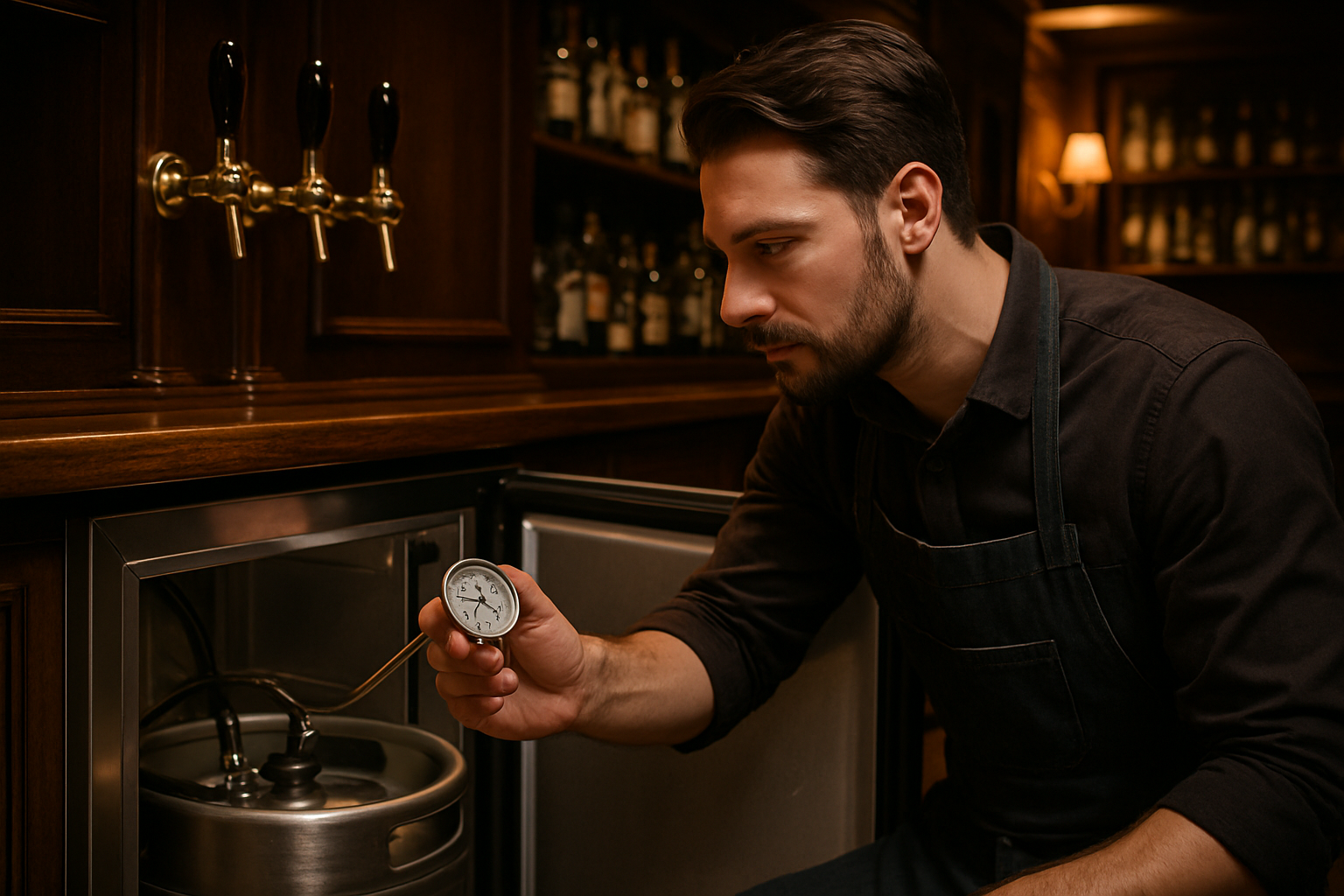
One important point about your kegerator temperature setting: measure it at keg level, not at the air thermostat probe position. Probe placement errors cause operators to believe they’re hitting 38°F when the keg actually sits at 42°F or warmer.
How Kegerator Thermostats Work and Where They Fail
Most kegerators use a basic bimetal or digital thermostat to regulate the compressor cycle. The probe reads ambient air temperature inside the unit. It triggers cooling when the reading exceeds the set point. This works adequately under stable conditions. However, it introduces inaccuracies under real-world use.
Common failure points in your kegerator temperature setting include:
- Probe placement near the door: Air near the door is warmer and more variable than air near the keg. A probe in this location causes the compressor to overcorrect.
- Frequent door openings: Every door opening in a busy bar environment allows warm air to rush in. This forces the compressor to work harder, creating temperature swings.
- Inadequate insulation or seal deterioration: Gasket wear on older units allows ambient heat to enter. This is particularly problematic in warm kitchen environments or outdoor setups.
- Single-zone thermostats on multi-keg units: One probe cannot accurately represent temperature variance across a unit holding four or more kegs.
Discussions on community forums like Homebrew Talk frequently highlight thermostat placement and compressor cycling. These represent the top causes of inconsistent pour quality in home kegerators. Moreover, they reflect the operational reality of most consumer units.
For commercial applications, upgrading to a dual-zone or glycol-cooled system is often the most reliable solution. Glycol systems maintain consistent temperatures across long draw lines. They do this regardless of ambient room temperature, making them the standard for larger bars and taprooms.
Understanding how to clean beer lines connects directly to your kegerator temperature setting. Warm or inconsistent temperatures accelerate microbial growth inside the lines. Therefore, regular cleaning becomes not just a quality issue but a safety one.
Temperature Fluctuations and Their Impact on Beer Quality
Stable temperature is as important as the correct kegerator temperature setting. A kegerator cycling between 34°F and 44°F throughout the day causes more damage than one held consistently at 40°F.
Temperature swings cause CO2 absorption and release to oscillate. When beer warms, it releases CO2. When it cools again, carbonation partially re-dissolves but never fully recovers. Over time, this degrades the carbonation profile and leads to foamy pours early in the day. By closing, the beer turns flat.
US Cooler reported a 36% performance improvement in temperature stability in upgraded commercial-grade kegerators. Furthermore, nearly 29% of users saw better keg life as a result (2025). These figures underscore what experienced operators already know from practice. Investing in stable, well-insulated equipment pays off in reduced waste and consistent service.
From a hygiene standpoint, temperature fluctuations create conditions accelerating bacterial and yeast growth inside beer lines. For this reason, beer line cleaning frequency must be evaluated in context of your kegerator’s operating environment. A system running warm or inconsistently may need cleaning more often than the standard two-week interval used in stable commercial environments.
Knowing how to change a keg properly also matters here. A keg sitting unconnected or partially tapped at incorrect temperatures loses carbonation rapidly. This affects the first several pints poured after reconnection.
Setting Up and Calibrating Your Kegerator the Right Way
Proper setup begins before the first keg goes in. The following process reflects best practices used in both commercial installations and well-maintained home systems for correct kegerator temperature setting.
Step 1: Pre-cool the unit before loading.
Run the empty kegerator for at least 24 hours before placing a keg inside. This establishes a thermal baseline and identifies any cooling inconsistencies before product is at risk.
Step 2: Place an independent thermometer inside.
Never rely solely on the built-in thermostat readout. A secondary probe thermometer placed at keg level gives a more accurate reading of actual beer temperature during your kegerator temperature setting process.
Step 3: Set the thermostat to 38°F as a baseline.
For American lager and most commercial draft beers, 38°F is the industry standard starting point for your kegerator temperature setting. Adjust from there based on the specific style being served.
Step 4: Allow 24 to 48 hours after loading a new keg.
A freshly loaded keg that traveled in a warm delivery truck needs time to equalize. Pouring during this equalization period almost always results in excessive foam.
Step 5: Monitor CO2 pressure in relation to temperature.
CO2 pressure and temperature are inseparable variables. At 38°F, most draft beers require approximately 10 to 12 PSI to maintain carbonation. Raising temperature without adjusting pressure is a direct cause of over-carbonation and foamy pours.
Step 6: Inspect door seals quarterly.
Gasket degradation is slow and easy to miss. A simple test is placing a sheet of paper in the door seal and pulling. If it slides out without resistance, the seal needs replacement.
Commercial vs. Residential Kegerator Temperature Standards
The principles of kegerator temperature setting apply across both commercial and residential environments. However, the stakes and solutions differ considerably.
According to 2025 industry data, commercial applications dominate with a 65% market share. This is driven by hospitality and event sectors. Meanwhile, residential is the fastest-growing segment with a CAGR of 8%, fueled by home brewing and DIY culture. This growth reflects a broader cultural shift. Nearly 49% of homeowners are upgrading spaces with draft systems. Additionally, nearly 58% of U.S. consumers prefer freshly poured drinks at home, according to Global Growth Insights (2025).
For commercial operators, expectations regarding kegerator temperature setting are more demanding. A bar or restaurant serves dozens to hundreds of pints per shift. Even minor temperature inconsistency translates directly into measurable product waste and guest complaints. Commercial setups typically use glycol cooling systems, remote monitoring, and professional maintenance schedules. They rely less on factory thermostats.
For residential users, a quality consumer-grade kegerator with a reliable thermostat and secondary thermometer is usually sufficient. This works provided it is placed in a climate-controlled space. Additionally, it should not be subjected to significant ambient temperature swings.
Operators uncertain about whether their current setup performs within acceptable kegerator temperature setting ranges should consider a professional system assessment. Beer Line Cleaning USA provides draft system consulting, maintenance, and equipment solutions for bars, restaurants, breweries, taprooms, and hospitality venues across New York, New Jersey, and Connecticut, including the NYC metro area, Westchester, and Putnam County. Understanding how much does beer line cleaning cost is useful for operators building their total draft system maintenance budget.
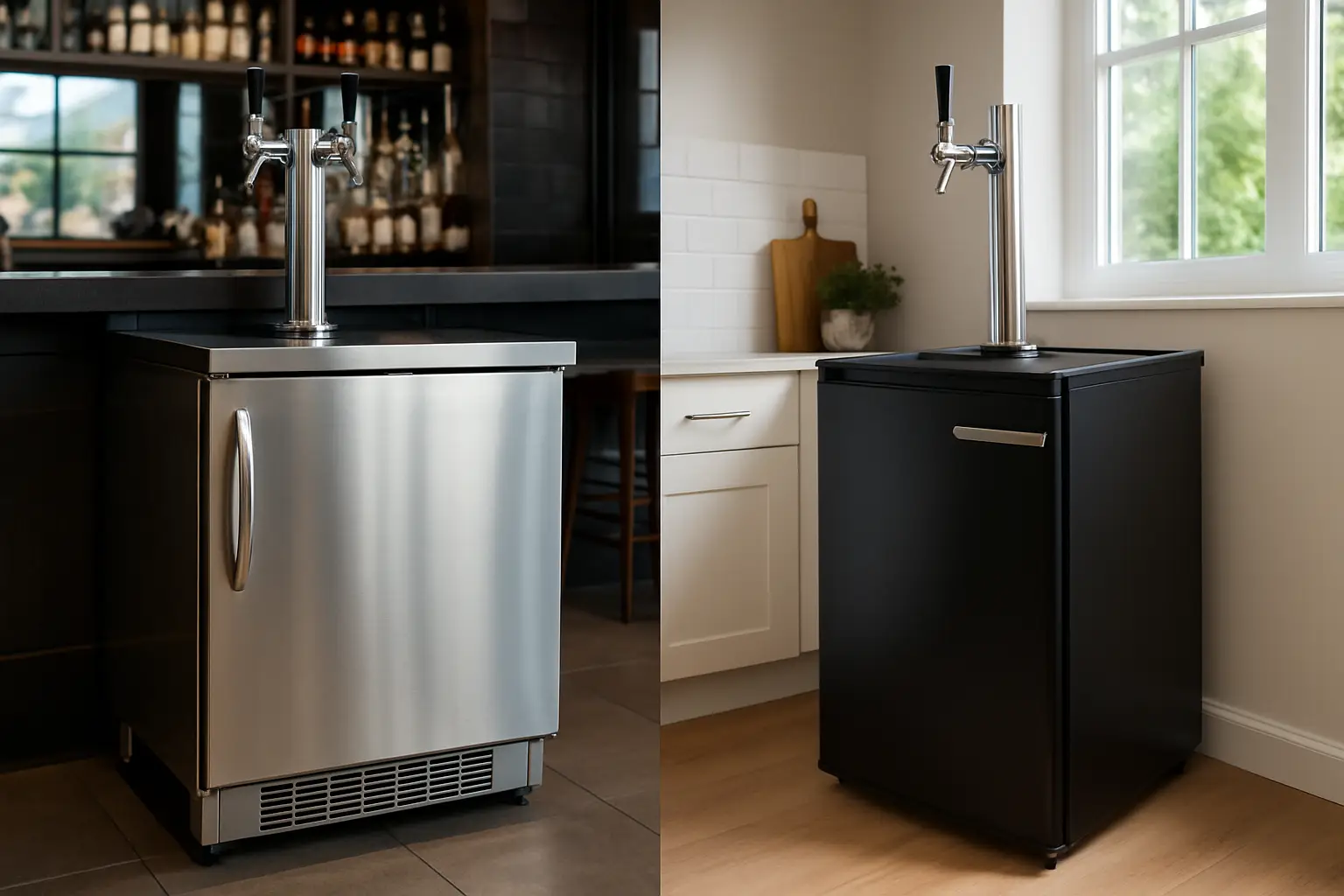
Single-tap kegerators lead the residential segment with a 54.0% market share. Full-size units dominate commercial setups with a 61.5% share, according to 2025 market data. These figures reflect practical realities. Home users typically need one tap. Commercial operations need the capacity and durability that larger units provide.
Regardless of scale, the principles of proper kegerator temperature setting remain constant. Temperature stability, accurate measurement, style-appropriate settings, and regular maintenance define the difference between a system that performs consistently and one that wastes product and frustrates customers.
Things to Know
- The temperature inside a kegerator should always be verified with a secondary thermometer placed at keg level. The built-in thermostat display can read several degrees warmer or cooler than actual keg temperature depending on probe placement.
- CO2 pressure and temperature are interdependent variables. Changing one without adjusting the other is the most common cause of chronic foamy or flat pours in both home and commercial systems.
- A freshly delivered keg should rest inside the kegerator for 24 to 48 hours before regular service begins. Pouring too early, before the keg fully equalizes to the set temperature, almost always produces excessive foam regardless of pressure settings.
- Warmer kegerator temperatures accelerate microbial growth inside beer lines. Operators running systems at the higher end of the acceptable range should evaluate their cleaning schedule more frequently than those maintaining stable, colder temperatures.
- Door seal integrity is one of the most overlooked maintenance items on kegerators. A degraded gasket allows ambient warm air to enter continuously. This forces the compressor to cycle more aggressively, creating the temperature fluctuations that damage beer quality over time.
- Not all beer styles belong at the same temperature. Setting a stout or Belgian ale to the same 36°F used for American lagers will mute the flavor complexity those styles are brewed to deliver. Style-appropriate kegerator temperature setting matters as much as hitting any single target number.
Stop Guessing Your Draft Temperatures and Start Serving Better Beer
Inconsistent kegerator temperatures quietly drain revenue through wasted kegs, poor pours, and guest dissatisfaction. Most operators don’t identify the root cause until the problem has persisted for months. Beer Line Cleaning USA works with bars, restaurants, taprooms, breweries, and hospitality venues across New York, New Jersey, and Connecticut. We assess, optimize, and maintain draft systems that perform consistently at every pour. Request a free quote today and get a professional evaluation of your draft system’s temperature performance, line condition, and maintenance needs. Tell the team your setup, your service volume, and your current challenges. They will respond with a clear, no-obligation plan.
Frequently Asked Questions
Q: What is the best kegerator temperature setting for most beers?
For most American lagers and standard commercial draft beers, a kegerator temperature setting of 36°F to 38°F is the widely accepted industry standard.
This range keeps carbonation stable and prevents excessive foaming at the faucet. Additionally, it preserves the flavor profile the brewer intended. Styles like IPAs, stouts, and Belgian ales benefit from slightly warmer settings. However, 38°F works as a reliable baseline for operators serving a mixed or general draft lineup.
Q: Why is my kegerator pouring foamy beer even though the temperature looks correct?
Foam is most often caused by a mismatch between CO2 pressure and actual keg temperature, not just the thermostat reading.
If the built-in thermostat reads 38°F but the keg itself sits at 43°F due to poor probe placement or a worn door seal, the CO2 pressure set for 38°F will cause over-carbonation and excessive foam. Always verify temperature with a secondary thermometer placed directly at keg level. Additionally, check door gasket condition if fluctuations are suspected.
Q: How often does a kegerator need to be cleaned, and does temperature affect that schedule?
Kegerator beer lines should be cleaned at minimum every two weeks under stable conditions. However, warmer or fluctuating temperatures may require more frequent cleaning intervals.
Heat accelerates bacterial and wild yeast growth inside draft lines. Therefore, a system running at 42°F or above consistently will develop contamination faster than one held steady at 36°F to 38°F. Temperature is one of several factors determining how aggressive a cleaning schedule needs to be. These factors include line length, traffic volume, and the types of beer being served.
Q: Can a kegerator be set too cold, and what happens if it freezes the beer?
Yes, setting a kegerator below 32°F risks freezing the beer, which damages carbonation, can crack the keg, and may cause line blockages that prevent dispensing entirely.
Most lagers and ales begin to freeze between 27°F and 30°F depending on their alcohol content. Alcohol lowers the freezing point slightly below water’s 32°F. Operators should avoid setting the thermostat below 34°F to maintain a safe buffer. If the unit is in a warm ambient environment and the compressor runs continuously, the actual internal temperature can drop lower than the set point during off-peak hours.
Q: Does the kegerator temperature setting need to change when switching beer styles?
Switching from a lager to a stout or Belgian ale ideally calls for a temperature adjustment upward by 5°F to 15°F depending on the style. However, single-zone systems often require a compromise setting.
In a single-tap kegerator, operators should adjust both temperature and CO2 pressure when changing to a new style with significantly different serving requirements. In multi-tap commercial setups, zone-specific temperature management or glycol systems allow different temperatures for different lines simultaneously. This is the preferred approach for venues serving a broad style range.