What’s In This Guide
- What Is the Difference Between a No-Pour and a Slow-Pour Problem?
- What Are the Most Common Causes of a Complete No-Pour?
- What Causes Slow or Inconsistent Pours in a Draft System?
- Does Beer Line Diameter Affect Pour Speed in a Draft System?
- How Do You Diagnose a Draft Flow Problem Step by Step?
- When Should Putnam County Bar Operators Call for Professional Draft Beer Services?
- Frequently Asked Questions (FAQs)
- Where Can Putnam County Bar Operators Get Help With Draft System Flow Problems?
Most no-pour and slow-pour problems can be traced to a handful of factors: gas supply, line condition, temperature, and equipment wear. Systematic beer dispense troubleshooting works through each variable in order, rather than guessing. Most issues are fixable without a service call if the root cause is identified early.
Quick Facts
- The Brewers Association’s recommended flow rate for a balanced draft system is two ounces per second.
- Correct CO2 serving pressure for most ales and lagers at 36–38°F falls between 10–14 PSI.
- Beer stone and biofilm narrow internal line diameter over time.
- A sudden no-pour after a keg change almost always comes from an empty CO2 tank, a closed valve, or a coupler that is not fully seated on the keg valve.
- Putnam County bars using glycol-cooled long-draw systems face near-freezing trunk line segments during winter that can slow or stop flow without an obvious cause.
What Is the Difference Between a No-Pour and a Slow-Pour Problem?
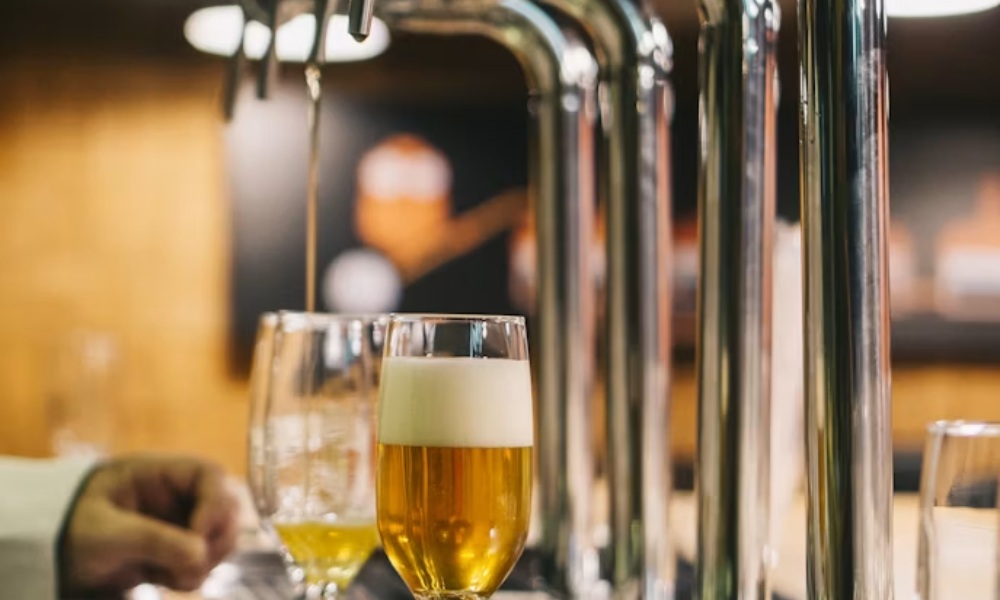
A no-pour means zero beer exits the faucet. A slow-pour means beer flows, but at a reduced, inconsistent, or foam-heavy rate. The root causes overlap, but the diagnostic starting point differs between the two.
|
Problem Type |
Definition |
Most Likely Starting Point |
|
No-Pour |
Zero flow from the faucet |
Gas supply, coupler, or hard blockage |
|
Slow-Pour |
Flow exists but is restricted or foam-heavy |
Pressure, dirty lines, warm temperature, or faucet wear |
Treating a slow-pour as a pressure problem and raising PSI often creates excess draft beer foam without fixing the underlying restriction. A correct diagnosis requires working through the system in sequence.
What Are the Most Common Causes of a Complete No-Pour?
A complete no-pour comes from one of three sources: no gas reaching the keg, a failed or improperly seated coupler, or a hard physical blockage in the line.
Is the CO2 Tank Empty or the Regulator at Fault?
Check the gas supply first. This is the most commonly overlooked cause of a sudden no-pour, particularly after a busy service period drains the tank.
- High-pressure gauge at 0, low-pressure gauge at 0: tank is empty or disconnected
- High-pressure gauge reading positive, low-pressure gauge at 0: valve is closed or regulator is failing
- Low-pressure gauge fluctuating unpredictably: regulator likely needs replacement
A secondary regulator serving a specific tap zone should also be checked when one line stops flowing while adjacent taps continue normally.
Is the Coupler Properly Seated on the Keg?
A coupler that has not locked fully into the keg valve will cut off beer flow entirely. Coupler failure is especially common after rushed keg changes during peak service.
Signs of a seating or coupler problem:
- Hissing near the keg valve, indicating a gas leak at the seal
- Beer stops flowing immediately after a keg swap with no change to gas or pressure settings
- Handle not fully depressed or the locking mechanism did not engage
- A failed internal check valve blocking flow even when the coupler appears correctly seated
Is There a Kink, Clog, or Frozen Segment in the Beer Line?
Beer lines develop full blockages from physical kinks, debris near a check valve or FOB device, or frozen segments in glycol-cooled long-draw systems.
Common blockage points in Putnam County bar setups:
- Tower base, where lines enter the tower and clearance is limited
- Cooler door passages, where repeated compression collapses flexible tubing over time
- Under-bar bends with tight angles in older bar builds
- FOB devices that were not reset after the last keg change
Bars throughout Putnam County, especially those operating older long-draw systems, should also check for near-freezing line segments during winter. An uninsulated trunk line section in an exterior wall or unheated basement can slow or stop flow even when the glycol system is otherwise operating.
MORE ON THIS TOPIC: Draft System Repairs & Maintenance
What Causes Slow or Inconsistent Pours in a Draft System?
Slow and inconsistent pours in beer dispense troubleshooting almost always come from one of three places: incorrect pressure, restricted lines, or a temperature break between the keg and the faucet.
How Does Incorrect CO2 Pressure Create a Slow Pour?
Pressure below the correct serving range forces beer through the system too slowly and allows CO2 to leave solution, which can also increase draft beer foam on subsequent pours.
- Most ales and lagers at 36–38°F require approximately 10–14 PSI as a general serving range
- According to the Brewers Association, a beer at 36°F with 2.6 volumes of CO2 has an ideal pressure of approximately 11.3 PSI, with adjustments required for altitude and system design
- Under-pressure causes slow flow and gradually flat beer as carbonation fails to hold
- Over-pressure produces excess draft beer foam that temporarily masks a restriction problem
Make pressure changes in 1 PSI increments and allow 24 hours before evaluating the result.
How Do Dirty Beer Lines Restrict Flow?
Beer stone (calcium oxalate deposits) and biofilm build up on the interior walls of beer lines. This narrows the available flow path, increases turbulence, and creates nucleation sites where CO2 breaks out of solution before beer reaches the glass.
The Brewers Association Draught Beer Quality Manual sets the standard cleaning interval at 14 days. Bars that fall behind on beer line maintenance often notice:
- Gradual slowdown in pour rate that worsens over weeks
- Persistent draft beer foam that regulator adjustments cannot resolve
- Off-flavors (buttery, sour, metallic) that intensify across taps
- Occasional sediment or haze in the finished pour
Consistent biweekly beer line maintenance helps prevent buildup from reaching the point where calcium oxalate deposits restrict flow.
How Does Temperature Affect Pour Rate in Putnam County Bars?
Beer stored at 38°F retains the carbonation created at the brewery. CO2 expands as beer warms above that target, causing carbonation to leave solution and increasing foam volume at the faucet. The proper dispensing temperature range is 34–38°F; consistent deviation above this range directly affects pour quality and yield.
Temperature problem areas common in Putnam County bar setups:
- Beer towers that warm significantly between pours during slow service periods
- Walk-in cooler doors left open during high-volume shifts
- Compact back-bar coolers with limited refrigeration capacity that cannot recover temperature quickly
- Seasonal kitchen or ambient heat affecting cooler performance during summer months
Does Beer Line Diameter Affect Pour Speed in a Draft System?
Yes. Beer line inner diameter directly controls flow resistance. Standard commercial systems use 3/16-inch inner diameter tubing for short-draw setups, which creates enough resistance to balance pressure and slow beer to the correct two-ounce-per-second rate.
Wider tubing, such as 1/4-inch or 5/16-inch inner diameter, reduces resistance and can cause beer to race through the line, producing excess draft beer foam rather than a slow pour.
Mismatched tubing diameters across a multi-tap system are a common oversight during installation and a frequent finding during professional beer line maintenance inspections.
How Do You Diagnose a Draft Flow Problem Step by Step?
Work through the following steps before adjusting pressure or scheduling draft beer services. Most no-pour and slow-pour issues can be isolated to a single cause within a few minutes.
Step 1: Check the Gas Supply and Regulator Readings
Read both the high-pressure and low-pressure gauges on the CO2 regulator. Confirm the tank valve is fully open. If one tap is affected and adjacent taps are not, check the secondary regulator serving that specific zone.
Step 2: Inspect the Coupler and Keg Connection
Remove and reseat the coupler. Confirm the handle is fully depressed and locked. Inspect the coupler body for cracks, worn O-rings, or signs of a failed internal check valve.
Step 3: Trace the Beer Line From Keg to Faucet
Walk the full line path visually and physically. Look for:
Visible kinks or pinch points at door frames, cabinet edges, or tight bends
Line sections that feel significantly colder than adjacent sections, which may indicate partial freezing in glycol-cooled systems
FOB devices that were not reset after the last keg change
Step 4: Run a Timed Pour Test and Record the Results
Pour into a measuring container and time the output over 10 seconds. A properly balanced system flows at approximately two ounces per second. Record the actual flow rate alongside current PSI and beer temperature to help a draft technician identify the fault quickly if the problem continues.
Step 5: Inspect the Faucet and Shank for Internal Buildup
Disassemble the faucet and examine the internal body for beer stone, debris, or corrosion. A worn faucet ball or deteriorated seal can partially obstruct flow without appearing visibly damaged from the outside.
When Should Putnam County Bar Operators Call for Professional Draft Beer Services?
Some flow problems go beyond what operators can isolate and fix independently. Bring in a technician when:
- Gas supply, coupler, and line path have all been verified, but the problem continues.
- One tap consistently underperforms while neighboring taps with similar settings pour normally.
- Flow rate has declined gradually over weeks, pointing to internal line restriction from calcium oxalate buildup.
- The system includes glycol cooling and trunk line temperature appears inconsistent.
- Multiple PSI adjustments have been made without stabilizing results.
- FOB devices were recently serviced without resolving the slow-pour condition.
- Recurring slow-pour problems after operator-level troubleshooting almost always point to a system-level issue, including line balancing, restriction buildup, or failing components that require line-by-line inspection and pressure testing by a qualified technician.
Frequently Asked Questions (FAQs)
Why did my draft beer stop pouring suddenly with no warning?
Sudden no-pour is most often caused by an empty CO2 tank, a tripped regulator, or a coupler that shifted on the keg during high-volume service. Check the gas supply first, then the coupler, then inspect for a kink in the line closest to the keg valve.
Can a dirty faucet cause a slow pour?
Yes. Beer stone and residue inside the faucet body narrow the internal flow path, creating a restriction that slows output even when line pressure and temperature are correctly set. Faucet disassembly and cleaning is a required component of any complete beer line maintenance visit.
How do I tell if my CO2 regulator is failing or if the tank is just empty?
Check the high-pressure gauge first. A reading above zero means gas remains in the tank. If the high-pressure gauge reads above zero but the low-pressure gauge reads zero or fluctuates unpredictably, the regulator is the source of the problem, not the tank.
What PSI should a draft system run at to avoid slow pours?
Most standard ales and lagers served at 36–38°F fall within the 10–14 PSI range as a general starting point. The Brewers Association notes that a beer at 36°F with 2.6 volumes of CO2 has an ideal pressure of approximately 11.3 PSI, with altitude and system design requiring further adjustment.
Can a FOB detector cause a no-pour or slow-pour problem?
Yes. A FOB (Foam on Beer) detector that was not properly reset after a keg change will block flow entirely, mimicking a complete no-pour. Even a partially reset FOB can restrict flow enough to produce a slow, inconsistent pour. After every keg change, confirm the FOB device is reset and purged before resuming service.
Where Can Putnam County Bar Operators Get Help With Draft System Flow Problems?
Beer Line Cleaning USA provides professional draft beer services and beer line maintenance for bars, restaurants, and taprooms throughout Putnam County, with experience across more than 3,000 commercial installations.
Schedule a service visit with Beer Line Cleaning USA and get your draft system flowing correctly.