Many bar operators assume that draft beer line length is a fixed standard. In reality, the right length is determined by resistance in the beer line, applied keg pressure, elevation changes, tubing material, and serving conditions.
The most important factor to understand first is line resistance. Different materials and diameters create very different pressure drops per foot of tubing.
Plastic tubing smaller than 3/16″ ID is generally not recommended because the resistance is too high for practical draft systems.
Understanding these resistance values helps explain why there is no single correct length for draft lines.
What’s In This Guide
Quick Facts 🍺✔ No single draft line length fits every system. ✔ Line length depends on resistance, pressure, temperature, and elevation. ✔ Tubing size and material affect the required length. ✔ Poor pours are not caused by line length alone. ✔ A balanced system reduces foam and improves service.
|
How Long Should Draft Lines Be?
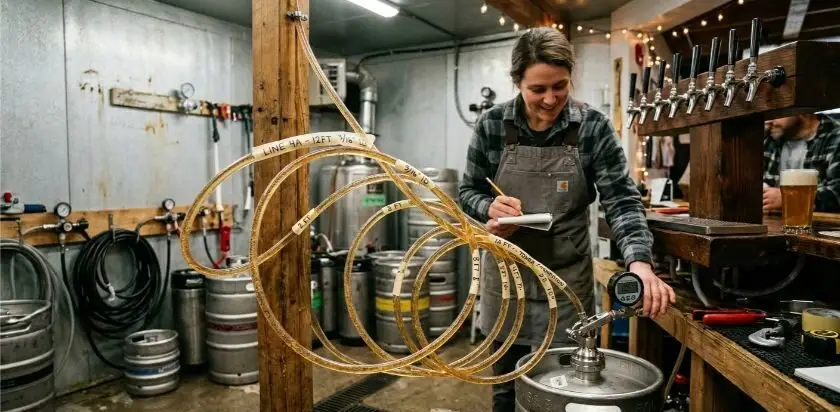
There is no universal beer line length that works for every draft system. The correct draft beer line length is the length that balances the system so that the pressure at the faucet is low enough to prevent foam but still high enough to allow a smooth pour.
A balanced system typically aims for less than 1 psi of pressure at the faucet.
If pressure remains too high when the beer reaches the tap, the beer exits the faucet too quickly and creates foam. If pressure drops too low, the pour becomes slow, and carbonation can fall out of solution.
To determine line length, installers calculate how much resistance is needed to reduce keg pressure down to near-tap pressure.
A simplified balancing formula is:
L = (keg pressure − tap pressure) ÷ line resistance |
For example, consider a system running at 12 psi with 3/16″ vinyl tubing, which provides about 3 psi of resistance per foot.
Using a target faucet pressure of roughly 1 psi:
L = (12 − 1) / 3 L ≈ 3.66 feet |
In this case, a beer line just under four feet would balance the system.
If the same system used 1/4″ vinyl tubing, which has only 0.85 psi per foot of resistance, the calculation changes:
L = (12 − 1) / 0.85 L ≈ 12.9 feet |
The larger tubing requires a much longer run to achieve the same pressure drop. This example illustrates why tubing diameter and material matter as much as the physical distance between the keg and faucet.
What Actually Determines the Right Beer Line Length?
Several factors influence the correct beer line length in a draft system.
Applied Gas Pressure
The pressure applied to the keg must maintain the beer’s carbonation level. Carbonation levels are determined by the combination of temperature and applied pressure, which means these two factors must be considered together when designing a draft system.
Most standard American lagers are served around 2.4 to 2.6 volumes of CO₂, though carbonation levels vary by style.
Beer Temperature
Beer temperature affects how easily carbon dioxide escapes from solution. Warmer beer releases gas more quickly, which increases foaming. Maintaining consistent temperature throughout the draft system helps stabilize carbonation and flow.
Tubing Diameter and Material
Different tubing materials produce very different levels of resistance.
For example:
- 3/16″ vinyl tubing: High resistance, commonly used in short runs
- 1/4″ vinyl tubing: Lower resistance, often used when longer runs are required
- Polyethylene tubing: Lower resistance than vinyl
- Stainless tubing: Extremely low resistance and often used in trunk lines
Because resistance varies so widely, two systems with the same physical length may require completely different tubing choices.
Elevation Changes
Elevation also affects system pressure. A common rule used in draft system design is that beer loses roughly 0.5 psi for every foot of vertical rise.
If the faucet is positioned above the keg, pressure drops as the beer travels upward. If the faucet is lower than the keg, pressure increases slightly as gravity assists the flow.
This factor must be included in system calculations.
Distance Between Keg and Faucet
Short direct-draw systems may only require a few feet of tubing. Remote systems that run from a walk-in cooler to a bar tower may require much longer runs and additional equipment to maintain temperature and balance.
Direct-Draw vs. Long-Draw Systems: Why the Answer Changes
Draft system design changes significantly depending on the distance between the keg and the faucet.
Direct-Draw Systems
Direct-draw systems are common in bars, taprooms, and kegerators where the keg sits directly below or near the tap tower.
In these systems:
-
- Beer travels a short distance
-
- Restricted tubing, such as 3/16″ vinyl, often provides the necessary resistance
-
- System balancing is relatively straightforward
Many small restaurants and cafes use this setup.
Long-Draw Systems
Long-draw systems are used in larger venues where kegs are stored in remote coolers away from the bar area.
These systems may include:
-
- Insulated trunk lines
-
- Glycol cooling systems
-
- Mixed gas blends
-
- Choker lines near the faucet
Because beer travels a much longer distance, balancing the system requires more careful design and engineering.
Why System Type Matters
A beer line length recommendation that works in a refrigerator setup may be completely wrong for a bar with a remote walk-in cooler. Understanding the system type is essential before calculating line length.
Signs Your Beer Lines May Be the Wrong Length
Draft system imbalance often reveals itself during daily service.
Common warning signs include:
- The beer is pouring too fast
- excessive foam during normal pours
- slow pours despite correct pressure
- inconsistent head formation
- carbonation that seems too high or too low
- Bartenders frequently adjust regulator settings
However, incorrect line length is not always the cause. Other issues, such as dirty lines, incorrect gas blends, or temperature fluctuations, can create similar symptoms.
How To Estimate the Right Beer Line Length for Your System
A balanced draft system depends on several measurable factors, including serving pressure, tubing resistance, and vertical rise. Operators can follow a basic process to estimate the correct draft beer line length.
Step 1: Start With Your Serving Conditions
Before you estimate beer line length, confirm the beer’s serving temperature and carbonation target. These two details determine the pressure needed to keep the product stable in the keg and through the pour. If you skip this step, any length estimate will be based on the wrong starting point.
Step 2: Identify the Exact Tubing You’re Using
Check the line material and inside diameter, since resistance changes a lot from one type of tubing to another. A short section of high-resistance tubing can behave very differently from a longer section of lower-resistance tubing. Even a small size change can throw off the balance.
Step 3: Measure the Actual Run
Measure the real path from keg to faucet, including bends, routing, and any vertical rise. Do not rely on a straight-line guess. If the faucet sits above the keg, that added height affects pressure loss and should be included in the estimate.
Step 4: Calculate the Resistance You Need
Once you know the serving pressure, tubing resistance, and elevation change, estimate how much total resistance the line needs to create a controlled pour. The goal is simple: enough resistance to prevent beer from rushing out of the faucet, but not so much that service becomes slow.
Step 5: Test the Pour and Fine-Tune if Needed
After installing the estimated line length, run a few test pours and watch for speed, head formation, and consistency. If the pour is too fast, too slow, or still unstable, small adjustments may be needed. A properly balanced line should produce a steady pour without forcing staff to keep changing pressure settings.
Factors That Influence Pour Quality Beyond Line Length
Even when the beer line length is calculated correctly, several other factors in the draft system affect how beer flows from keg to glass. Paying attention to these elements helps maintain consistent pours and prevents problems that may otherwise be blamed on line length.
Faucet and Coupler Condition
If the faucet or coupler is worn, dirty, or not installed correctly, beer flow can become uneven.
Common issues include:
- Buildup inside the faucet
- Worn seals or parts
- Loose coupler connections
- Poor cleaning habits
These problems can create turbulence and excess foam at the tap.
Gas Setup
The gas pushing the beer also plays a major role in draft quality.
Important points include:
- Many systems use CO₂
- Some setups require blended gas
- The wrong gas setup can affect carbonation
- Unstable carbonation can lead to poor pours
The gas type should match the beverage and system design.
Temperature Control
Even small temperature shifts near the tower or faucet can affect foam and consistency.
Key factors include:
- Tower insulation
- Proper cooling of the tap
- Avoiding warm spots in the line
- Steady cooler temperatures
A balanced draft system depends on more than line length alone. When these supporting elements are working properly, pours are more consistent and easier to manage.
Frequently Asked Questions (FAQs)
How often should draft beer lines be checked for balance?
Draft beer lines should be reviewed whenever pours become inconsistent, foam increases, service slows down, or a beverage program changes. Even without obvious issues, periodic system checks help catch small performance problems before they affect product quality.
Can beer line length affect bartender speed during service?
Yes. If the line is too restrictive, pours can take longer than necessary, which slows service during busy periods. A properly balanced line should support a controlled pour without creating delays at the bar.
Should seasonal or limited-release beers be evaluated differently?
They can be. Seasonal and specialty beers may have different carbonation levels or serving requirements than core products. If a new beer pours differently on an existing setup, the system may need adjustment rather than assuming the product is the problem.
Is it better to replace beer lines or shorten them when pours are off?
Not always. The right fix depends on the source of the issue. In some cases, the line material or diameter is the real problem, not the length itself. Shortening the line without checking the full setup can make the pour worse.
Do newer draft systems still need manual line balancing?
Yes. Even with updated equipment, draft systems still need to be balanced based on pressure, tubing, and layout. Modern components can improve consistency, but they do not remove the need for proper system design.
Improve Draft Performance With Professional Beer Line Service in Putnam County
Beer Line Cleaning USA provides draft system services designed to keep beverage programs running smoothly. With routine maintenance and system checks, operators can maintain balanced pours, reduce product waste, and deliver consistent draft quality to every customer in Putnam County.